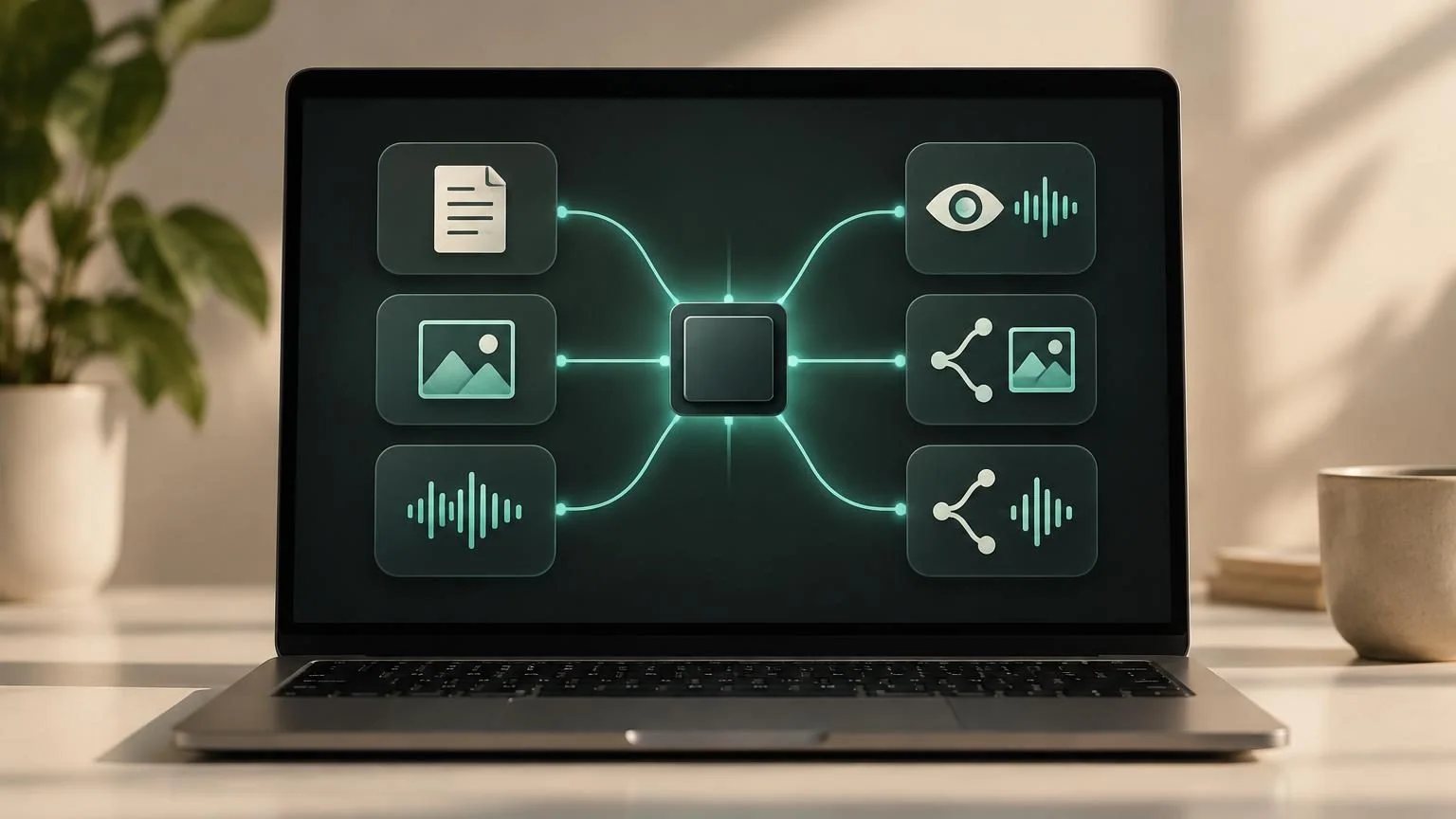
Liquid AI released LFM3 on October 27, 2026: six small models covering text, vision, audio, combined modalities, and structured decisions on a shared backbone. Downloadable checkpoints expand the options for local assistants and specialized automation, with licensing and runtime support that need to be checked for each deployment.
What shipped on October 27—and what “available” means
Liquid’s announcement says base and post-trained models became available through Hugging Face, its Playground and the Liquid AI API that day. Its separate Hugging Face launch article, also dated October 27, confirms downloadable weights and provides inference examples. This was an announced weight release, not merely a preview or promise of future downloads.
These access routes are different: Playground enables interactive evaluation; the API is hosted access; downloaded weights enable self-managed inference. The announcement does not establish a universal production SLA or identical feature support across every runtime. Treat provider availability and your chosen local runtime as separate checks.
All six models and their modalities
The family branches from LFM3-1.7B-Base, which is also available for post-training. The six announced application models are:
- LFM3-1.7B: text input and text output, including tool calling and structured outputs; a 256K-token context window.
- LFM3-VL-2B: text, image and video inputs; text output. Its model card specifies a 128K context, not the text model’s 256K.
- LFM3-Audio-2B: text and audio inputs; text and speech outputs, with transcription, synthesis and translation across 18 languages. Its card separately limits voice chat to English.
- LFM3-Omni-2B: text, images, video and audio inputs; text and speech outputs, including questions that depend on video and its soundtrack together.
- d1-2B: text, image and video inputs; typed answers with probabilities rather than generated conversational text.
- d1-Omni-2B: adds audio inputs and spoken questions to multimodal decision-making; outputs typed answers and probabilities, not speech or transcripts.
The practical distinction is output, not just input. For a proposed invoice workflow, d1-2B could extract fields or classify exceptions; a generative checkpoint could draft an explanation. For voice-message routing, evaluate d1-Omni-2B; for a spoken reply, evaluate Audio or Omni. These are deployment hypotheses, not results from Nerova testing.
The license is restricted—not Apache 2.0
All six model cards identify LFM Open License v1.0. The actual license grants modification and distribution rights subject to conditions, including a commercial-use restriction. It is not Apache 2.0, and downloadable weights do not mean unrestricted commercial deployment.
Section 1 defines a revenue threshold of $10 million or more; Section 5 says commercial use by an entity exceeding that threshold is not licensed under the agreement. The legal-entity definition includes controlled and commonly controlled entities. Businesses approaching that boundary should obtain written licensing clarification rather than evaluate eligibility using one department’s budget. Redistribution also carries license and notice obligations.
Where the local-agent opportunity meets its limits
The text model’s tri-hybrid architecture combines convolutions, sliding-window attention and global attention. Its card describes roughly 1 GB at four-bit precision, but that is not a complete application memory budget: context, runtime and other workflow components still need headroom.
More importantly, Liquid explicitly does not recommend LFM3-1.7B for agentic coding or complex multi-step reasoning. The d1-2B card warns that answers become less reliable beyond about 64K tokens of state; d1-Omni-2B warns about long spoken passages and recommends d1-2B when audio is unnecessary. These are material boundaries, not footnotes to a universal-agent claim.
Our operational reading: pilot one bounded decision or tool action first. Measure incorrect routing, missed fields, escalation frequency and end-to-end latency on your own records. Keep consequential actions behind approval, and test the exact quantized checkpoint and runtime you intend to deploy. LFM3’s October release expands the local-model options; it does not remove the need to prove a workflow reliable.