
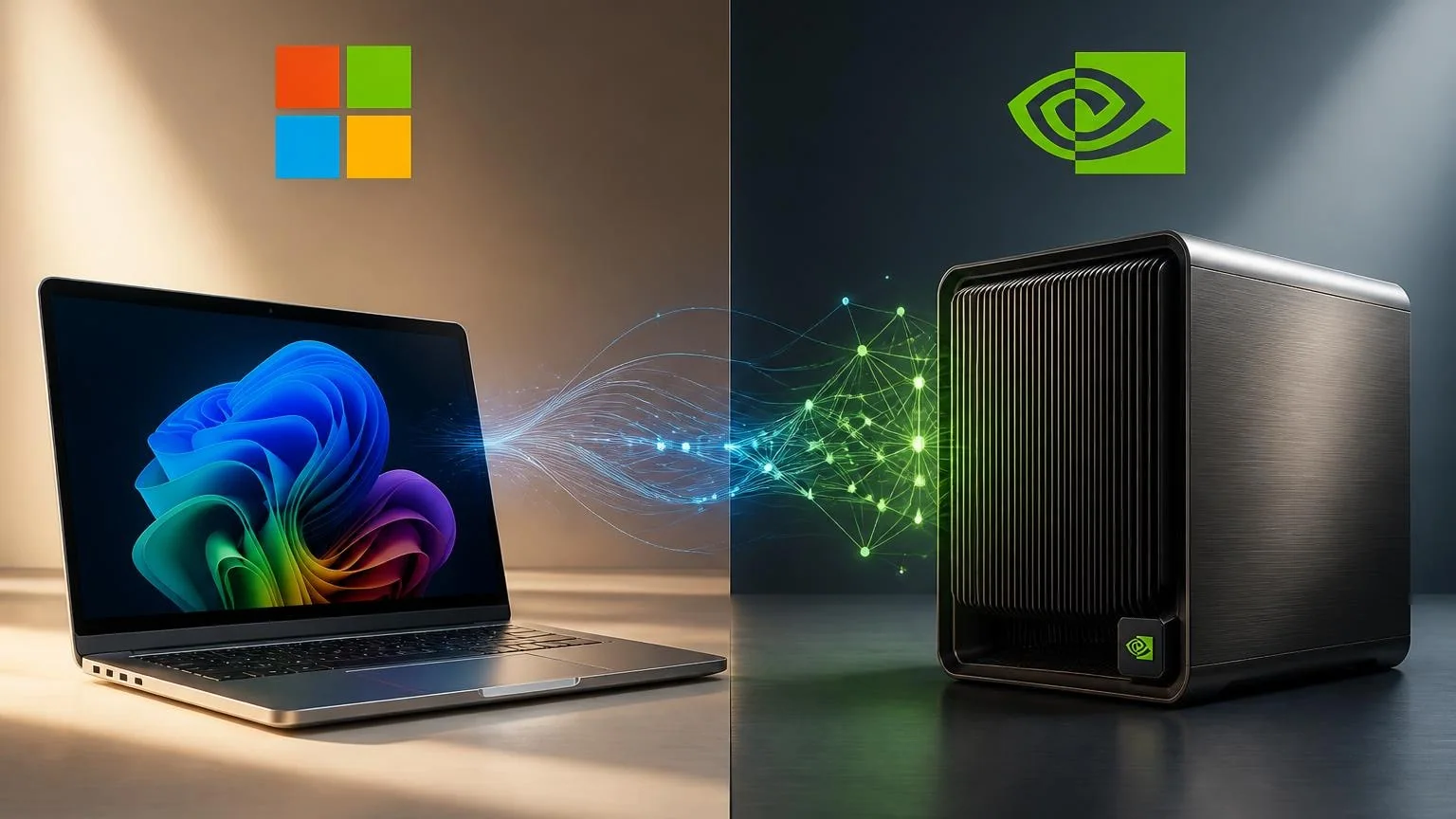
On May 31, 2026, NVIDIA and Microsoft used the Computex and GTC Taipei news cycle to announce a new Windows hardware-and-runtime stack for AI agents: the RTX Spark superchip for thin-and-light PCs, Microsoft’s new Surface Laptop Ultra built around that platform, and DGX Station for Windows for deskside enterprise AI workloads. The immediate headline is new hardware. The more important shift is that both companies are trying to make Windows a serious place to build, run and govern local AI agents.
That matters because most enterprise AI work still lives in a split world: lightweight assistants run on employee laptops, while the real agent infrastructure lives in Linux-heavy cloud or data-center environments. NVIDIA and Microsoft are now trying to close that gap from both directions at once.
What actually launched on May 31
The consumer-facing piece is RTX Spark, which NVIDIA describes as a new Windows PC platform built specifically for personal AI agents. NVIDIA says the chip delivers up to 1 petaflop of AI performance, up to 128GB of unified memory, and enough local capacity to run 120B-parameter models with very large context windows on device. Microsoft paired that launch with its own Surface Laptop Ultra, calling it the most powerful Surface laptop it has built and positioning it for creators, developers, and AI builders who need local model and rendering performance.
Just as important, Microsoft said RTX Spark systems are being optimized for Windows scheduling, unified memory, Windows ML, and new agent-specific security and containment features. In other words, this is not only a chip announcement. Microsoft is changing parts of the Windows platform itself to support on-device agent workloads.
The enterprise-facing piece is DGX Station for Windows. NVIDIA says the system is built on the GB300 Grace Blackwell Ultra Desktop Superchip, supports up to 748GB of coherent memory, can reach up to 20 petaflops of FP4 performance, and is designed to run frontier models of up to 1 trillion parameters locally. NVIDIA is explicitly pitching it as a Windows-native system for always-on agents connected to enterprise applications and workflows.
Why this is bigger than another AI PC refresh
The important change is the software and security model sitting underneath the hardware. Microsoft said it is adding OS-enforced identity, containment, and manageability for agents on Windows. NVIDIA is bringing OpenShell to Windows on top of those primitives, giving developers a runtime that can sandbox agents, apply policy outside the model itself, and keep agent permissions under tighter user and system control.
That is a meaningful shift from the earlier AI PC pitch. The first wave was mostly about copilots, NPUs, and battery life. This new wave is about whether a Windows machine can safely host an agent that sees local files, works across apps, reasons over long context, and takes action without shipping every step back to the cloud.
Microsoft’s own framing makes the broader ambition clear. The company is not only backing RTX Spark laptops and small desktops this fall. It is also positioning DGX Station for Windows as the upper end of the same stack, extending Windows from personal agent hardware into deskside enterprise AI infrastructure. That creates a more continuous path from local experimentation to serious departmental deployment.
Business impact lands in workflow design, not just device specs
For businesses, the most practical implication is that some agent workloads may move closer to the employee and the desktop application layer. Three areas stand out first.
Developer and technical workflows
Local coding, debugging, design, and content workflows benefit when agents can operate against files, IDEs, and creative tools with lower latency and better privacy boundaries. Microsoft specifically highlighted developer and creator scenarios, while NVIDIA tied the stack to OpenClaw, Hermes Agent, CUDA, TensorRT, and Windows-native agent experiences.
Regulated and data-sensitive work
Keeping more inference on device will appeal to teams that do not want every prompt, file interaction, or intermediate artifact sent back to a hosted model endpoint. That does not remove the need for cloud AI, but it does create a more credible hybrid model for organizations balancing privacy, compliance, latency, and cost.
Enterprise agent infrastructure on familiar IT ground
DGX Station for Windows may be the bigger long-term story for qualified buyers. NVIDIA is trying to put high-end agent development, inference, and simulation into a managed Windows environment that enterprise IT teams already understand. If that works, Windows stops being only the user surface and becomes part of the governed execution layer for AI agents.
That could matter in design engineering, simulation-heavy work, internal automation, and hybrid desktop workflows where agents need access to Windows software, local data, and enterprise controls at the same time.
What to watch next
The first thing to watch is whether the ecosystem actually ships against this vision on schedule. Microsoft said RTX Spark systems from Surface, ASUS, Dell, HP, Lenovo, and MSI are due this fall, while NVIDIA said DGX Station for Windows is coming in Q4 2026. Hardware announcements are easy; broad software support and stable agent behavior are harder.
The second question is whether Windows agent security becomes a real platform advantage. If OpenShell plus Microsoft’s new containment model gives enterprises a safer way to run cross-app local agents, Windows could become much more relevant in the next phase of agent deployment than the AI PC market alone suggests.
The third is whether businesses decide that local compute is now good enough for a meaningful slice of agent work. If so, the next enterprise AI architecture conversation changes from cloud versus on-prem to which agents run local, which run in the data center, and how they coordinate.
That is the deeper significance of this launch cycle. NVIDIA and Microsoft are not simply chasing better laptop benchmarks. They are trying to redefine Windows as a full agent platform, stretching from personal devices to deskside supercomputers, and that could reshape how AI agents are deployed across real business workflows over the next year.