
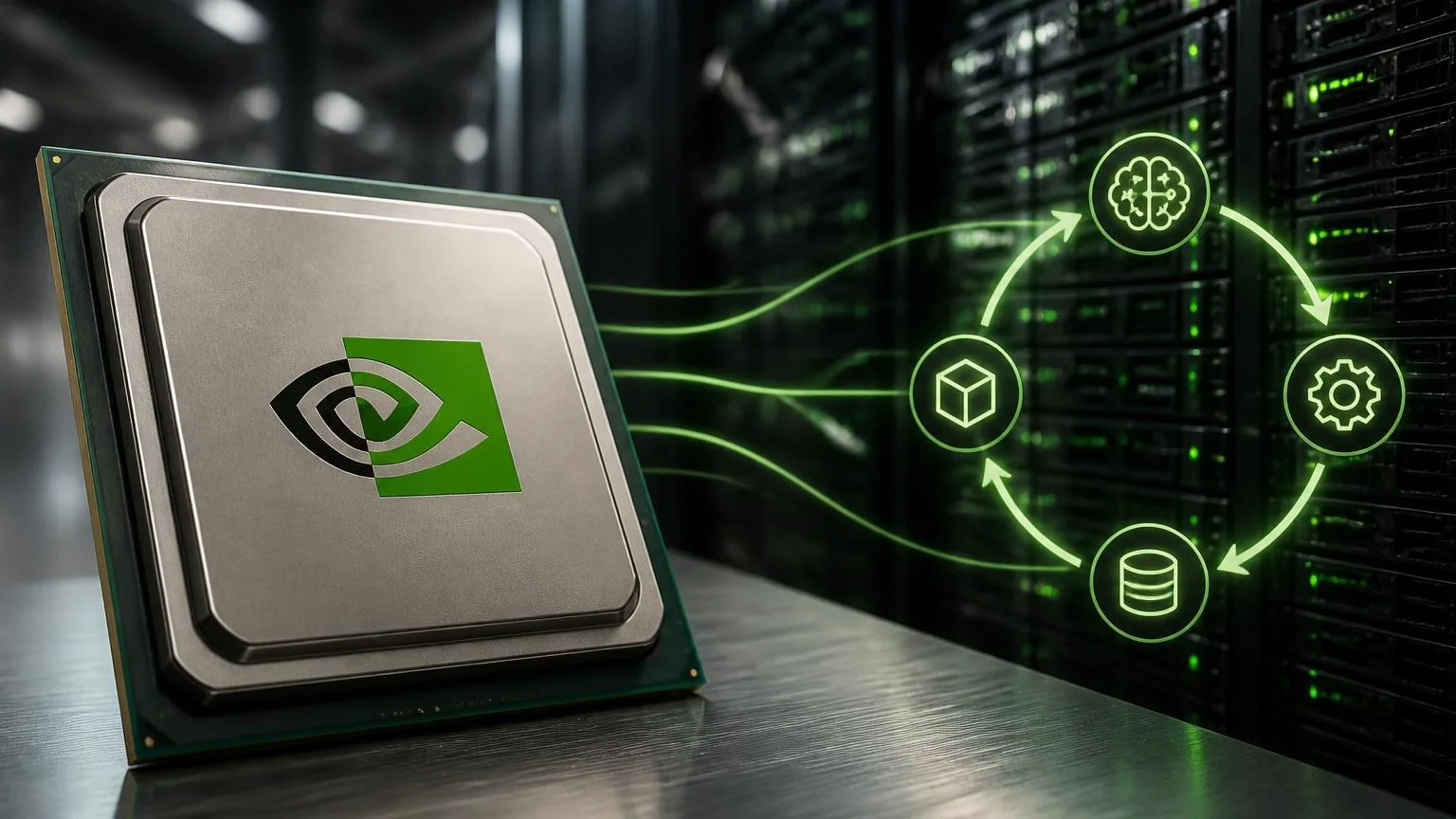
On May 31, 2026, at NVIDIA GTC Taipei, NVIDIA announced Vera, which it describes as the first CPU built for AI agents. The company said Vera is now in full production, will power standalone Vera servers, Vera Rubin systems, and Vera BlueField-4 STX storage platforms, and is already drawing planned adoption from companies including Anthropic, OpenAI, SpaceXAI, ByteDance, CoreWeave, and Oracle Cloud Infrastructure.
The immediate significance is not that NVIDIA has added one more processor to its catalog. It is that the company is trying to move the infrastructure conversation from GPU-only thinking toward the full agent loop: code execution, tool calls, retrieval, orchestration, and evaluation. For businesses building or buying agent systems, that makes Vera less a chip-launch story than a signal that CPU bottlenecks are becoming part of production AI economics.
What NVIDIA actually launched
NVIDIA says Vera is built around 88 custom Olympus CPU cores and up to 1.2TB/s of LPDDR5X memory bandwidth. In the company’s framing, that combination is meant to accelerate the CPU-heavy parts of modern agent systems: sandboxed code execution, Python and Java workloads, retrieval, data processing, and orchestration logic.
NVIDIA also says Vera delivers 1.8x faster task completion than x86 CPUs for the kinds of workloads that now sit inside agent loops. The company’s technical materials argue that this matters because many multistep agent tasks are sequential at the execution layer even when model inference is heavily parallelized on GPUs. If the CPU is slow, the whole workflow stalls.
Vera is not being positioned as a niche sidecar. NVIDIA says it will sit inside three different layers of its stack:
- standalone Vera CPU systems from OEMs such as Dell, HPE, Lenovo, and Supermicro
- the broader Vera Rubin AI platform
- Vera BlueField-4 STX storage platforms for AI factories
That is an important product signal. NVIDIA is trying to make the CPU part of the agent infrastructure platform, not an interchangeable host component hidden behind the GPU sale.
Why the CPU suddenly matters more for AI agents
NVIDIA’s technical case is straightforward: the model may decide what to do next, but the CPU often executes the step that makes the next model call possible. In practice, that means the CPU is increasingly responsible for running generated code, handling tool invocations, processing returned results, scheduling workflows, and managing data movement between steps.
That is a different workload from the classic cloud-era metric of packing in more cores for general virtual machines. NVIDIA is explicitly arguing for a new design point built around tokens per dollar rather than cores per dollar. In other words, the question is no longer just how many CPU instances a data center can rent out. It is how quickly the full agent loop can finish work without leaving accelerators waiting.
This is where Vera becomes strategically interesting for enterprise AI, even beyond NVIDIA’s performance claims. If agent systems keep taking more steps, using more tools, and running more validations, then CPUs become part of latency, utilization, and operating-cost math. That gives infrastructure buyers a new bottleneck to watch.
Business impact for AI infrastructure buyers
The clearest near-term impact is on AI factories and large inference environments, not ordinary enterprise servers. NVIDIA says a single Vera CPU rack can integrate up to 256 CPUs, support more than 22,500 concurrent CPU environments, and complete workloads up to 80% faster than traditional CPU infrastructure. The company is pitching that as a way to keep sandbox execution and reinforcement-learning environments from lagging behind GPU capacity.
For businesses outside hyperscale infrastructure, the practical implication is broader: agent performance will increasingly depend on the non-model parts of the stack. Teams that focus only on model benchmarks may miss where production latency actually lives. Tool execution, orchestration, policy checks, data processing, and context handling can become the slower and more expensive part of the workflow.
That also helps explain why NVIDIA linked Vera so tightly to Vera Rubin. In a separate May 31 announcement, the company said the full Vera Rubin platform delivers 10x agent throughput at scale versus the previous Grace Blackwell platform. Even if that claim is vendor-framed, the direction is clear: NVIDIA wants buyers to think of agentic AI as a rack-scale systems problem, not a model-selection problem.
For Nerova readers, the important takeaway is simple. Faster chips do not automatically create useful agents, but the infrastructure stack does shape what kinds of agents are viable. The more an AI workflow depends on code execution, retrieval, approvals, legacy-system actions, or repeated validation loops, the more CPU design starts to matter alongside GPU inference.
What to watch next
Three questions matter after this launch.
- Do planned adopters turn into real production volume? NVIDIA named major labs and cloud operators, but the market will now watch for actual deployments, customer case studies, and purchasing scale.
- Can CPU performance become a real buying category for agents? NVIDIA is trying to create one. That could force more direct competition with incumbent server CPU vendors on agent-specific workloads rather than generic enterprise compute.
- Will enterprises start measuring the full agent loop differently? If teams begin benchmarking orchestration time, sandbox latency, tool execution, and validation throughput more seriously, Vera’s positioning may look prescient rather than promotional.
The bigger pattern is that AI infrastructure is becoming more systems-oriented. Models still matter, but the next deployment gap may come from everything around the model: execution environments, storage, networking, and now the CPU path inside the agent loop. Vera is NVIDIA’s attempt to own more of that path before agentic AI spending fully matures.