
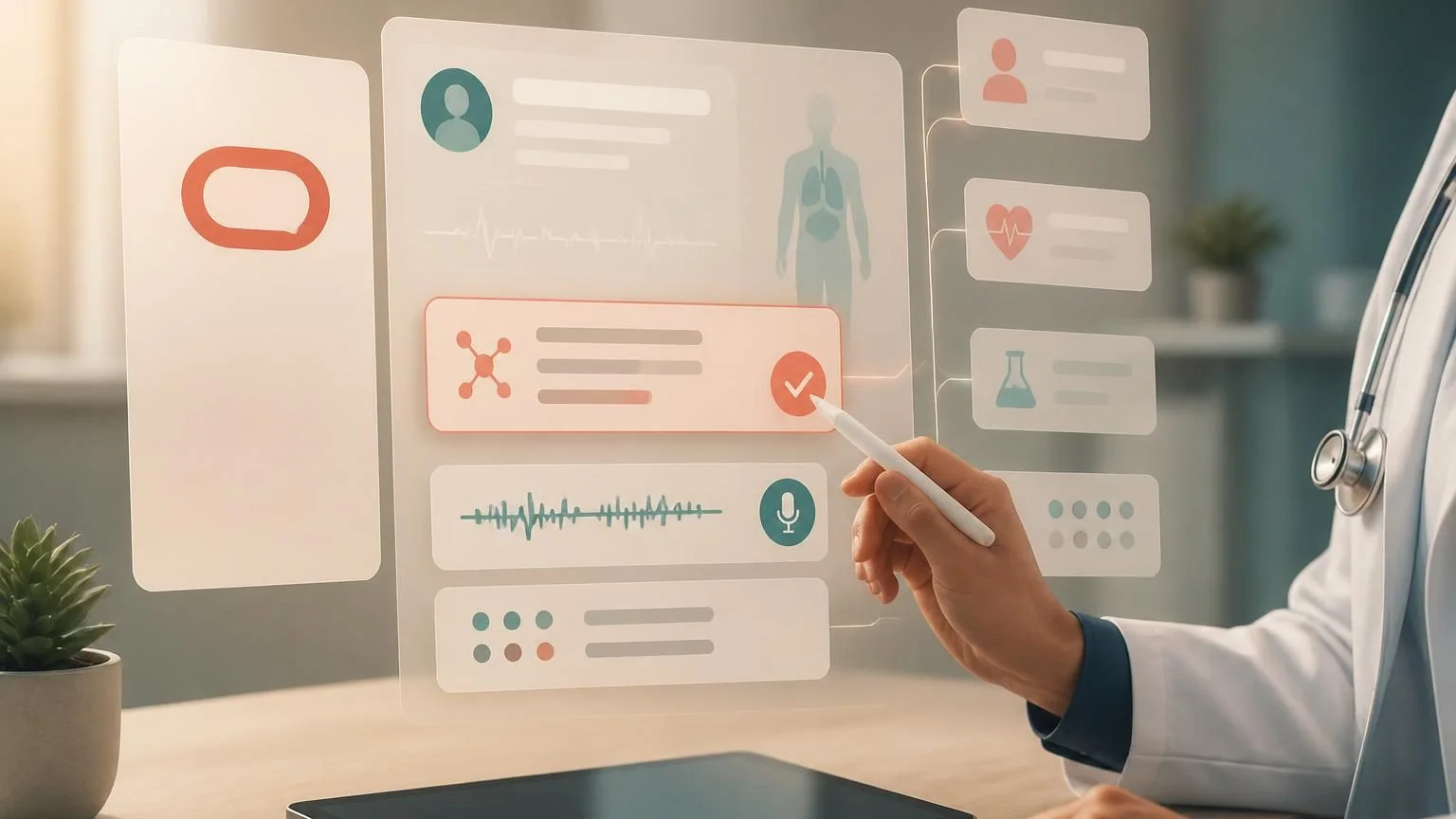
Oracle Health has expanded its Clinical AI Agent in the United States with three workflow capabilities: automated professional-fee coding for ambulatory care, clinician-controlled dictation, and chart review that surfaces relevant context from across the electronic health record.
The announcement matters because it shifts the role of clinical AI. Note drafting is a contained task. Coding suggestions, chart summaries, and information retrieval can affect documentation quality, revenue-cycle work, and how a clinician prepares for a patient encounter. That makes the surrounding workflow as important as the model output.
What Oracle says is changing
For ambulatory workflows, Oracle says the agent can analyze conversations during visits and suggest professional-fee charge codes in the orders workflow. Clinicians review and confirm recommendations before submission. Its dictation feature lets clinicians speak into documentation fields, then review, edit, and finalize the transcription. The chart-review function brings together relevant history, labs, medications, and other record information to help staff prepare for visits.
Oracle’s documentation describes the Chart Review Agent as a tool that generates contextual summaries and provides links to the record sources used for an answer. That source trail is a useful design signal. In healthcare, a summary without a clear path back to the chart can turn a time-saving feature into a verification burden.
The practical shift: from generated notes to coordinated work
These capabilities sit in different parts of the clinical workflow, but they create one shared governance problem. An organization needs to know what the agent saw, what it suggested, who reviewed it, what was changed, and what ultimately entered the record or billing process.
That is not an argument against workflow automation. It is the operating model that lets teams use it responsibly. A coding suggestion should not become a charge automatically just because it was plausible. A chart summary should support clinical preparation, not replace direct review of the underlying record. Dictation should speed capture, while the clinician remains responsible for the final documentation.
Three controls healthcare teams should define now
- Review ownership: Specify which role must review each type of suggestion and at what point in the workflow.
- Source visibility: Require users to be able to inspect the patient-record evidence behind an AI summary or recommendation.
- Auditability: Retain a trace of the agent output, human edits, approval status, and final action so teams can investigate exceptions and improve the process.
Oracle says its Clinical AI Agent note-generation capabilities have saved physicians more than 400,000 hours across U.S. health organizations since launch. That is a company-reported figure, not an independent clinical-outcomes study. The more durable lesson is that administrative relief only creates real value when teams can preserve professional judgment and make exceptions visible.
Why this is an enterprise AI story
Healthcare is showing the broader pattern for business AI. The highest-value deployments are increasingly not standalone chat windows. They are agents embedded in systems of record, where they summarize, retrieve, propose, and hand work back to people. As that happens, adoption decisions need to include workflow design, permissions, logging, escalation, and measurable quality checks.
For healthcare leaders, the question is not simply whether an AI agent can save clicks. It is whether the organization can prove that the right person reviewed the right recommendation with the right context. That is how automation earns trust at the point of care.
This article is for operational analysis, not medical, coding, legal, or compliance advice. Organizations should validate configurations, policies, and oversight requirements for their own settings.