
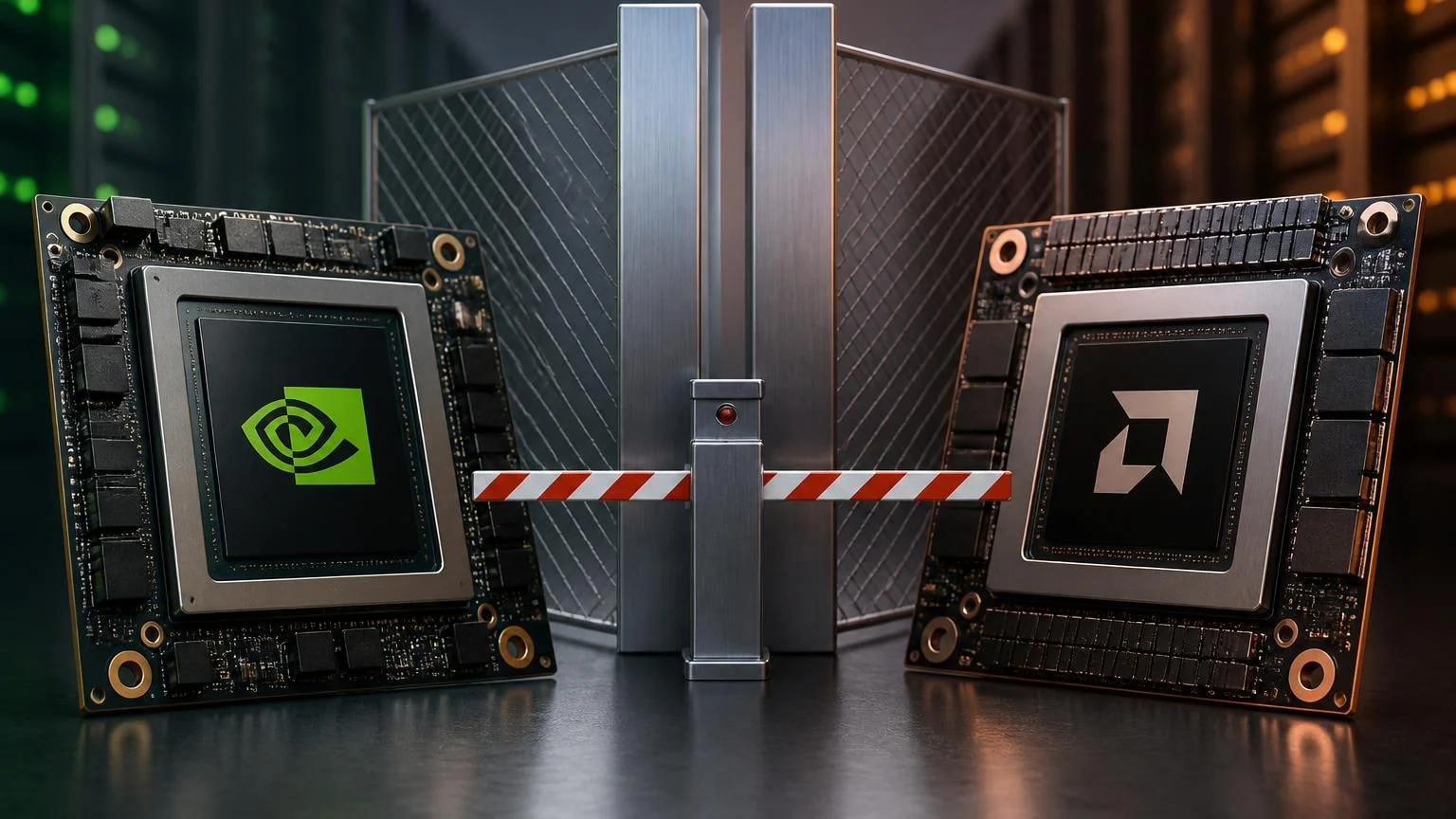
On May 31, 2026, the U.S. Department of Commerce moved to enforce license requirements for advanced AI chips sold to entities headquartered in China even when those entities are located outside China, according to Reuters. The move targets a path that may have allowed top-end Nvidia and AMD processors to reach overseas subsidiaries of Chinese firms in markets such as Malaysia, tightening a sensitive part of the global AI compute supply chain.
The Reuters report says the guidance covers some of the most advanced chips in the market, including Nvidia Rubin and Blackwell processors and AMD’s MI350X. It also says Commerce does not currently require data centers to stop using or servicing chips already installed, which makes this more of a forward-looking supply restriction than an immediate shutdown order for existing deployments.
What changed on May 31
Commerce posted unusual weekend guidance saying it would enforce license requirements for advanced chips when the customer is headquartered in China, even if that customer is based outside mainland China at the point of purchase. Reuters described the step as closing a loophole created after the Trump administration said in May 2025 that it would not enforce the broader AI Diffusion rule’s worldwide licensing requirements.
That matters because the practical question in AI infrastructure is often not just which country receives the chip, but who ultimately controls the compute. If a China-headquartered company could lawfully buy frontier chips through a foreign subsidiary, then export controls aimed at limiting China’s access to top-end AI compute would have been weaker than they looked on paper.
Reuters says it is unclear how many chips may have moved under that opening, but cited one industry source who estimated the number could be in the hundreds of thousands. The report also said subsidiaries in places like Malaysia were a focal concern.
Why this loophole mattered more than a trade-policy footnote
For AI model builders, cloud operators, and enterprise buyers, compute access is now a product issue, not just a foreign-policy issue. A large share of the current AI market depends on where top-end training and inference capacity can be installed, who can legally control it, and how fast it can be expanded across borders.
The U.S. had already built a more nuanced chip-control regime before this weekend. In January 2026, BIS said it would review export license applications for Nvidia H200, AMD MI325X, and similar chips to China on a case-by-case basis under specific security conditions. Legal analysis published shortly after that January change also noted that a separate end-user restriction still applied to certain exports outside China when the customer was headquartered in China or another restricted jurisdiction.
The significance of the May 31 guidance is that Commerce appears to be making the China-headquartered-entity issue operational again at the exact moment frontier AI demand is pushing companies to look for capacity wherever they can find it. In other words, the government is signaling that geography alone will not be enough to clear a transaction if effective control still points back to a restricted end user.
Business impact for AI infrastructure buyers
The immediate impact is not that every overseas data-center deployment involving Chinese firms suddenly goes dark. Reuters explicitly reported that Commerce is not ordering operators to rip out already installed hardware or stop servicing existing systems. The bigger effect is on new procurement, future buildouts, and supply-chain diligence.
- Cloud and colocation operators will face more pressure to verify the ultimate parent and control structure behind customers seeking high-end GPU clusters.
- Chip vendors and server integrators may need tighter screening for overseas subsidiaries, especially in regional hubs that sit outside China but serve Chinese technology groups.
- Enterprise AI teams should expect more volatility around where regulated compute can be sourced, hosted, or contracted, especially for large-scale training and high-end inference.
- Agent builders should pay attention because long-running multi-agent systems increasingly depend on stable access to premium compute, not just model APIs.
There is also a competitive angle. If the U.S. is tightening enforcement around China-controlled access to top-tier Nvidia and AMD systems, that raises the strategic value of non-U.S. compute alternatives, sovereign deployments, and domestic Chinese chip programs. It also reinforces a bigger 2026 pattern: AI infrastructure policy is being written around control, ownership, and installed base, not just raw semiconductor performance.
What to watch next
The first question is whether Commerce follows this guidance with more formal enforcement actions, added reporting requirements, or clearer screening obligations for exporters and data-center intermediaries. The second is whether Nvidia, AMD, hyperscalers, and major server vendors change customer-screening language or regional sales processes in response.
The third issue is market structure. If China-headquartered firms face tighter barriers to acquiring frontier AI chips through overseas entities, demand may shift harder toward approved mid-tier chips, alternative suppliers, or more aggressive in-country stack development. That would affect not only semiconductor revenue, but also where future model training, inference, and agent deployment capacity gets built.
For businesses deploying AI agents and automation, the practical takeaway is simple: compute policy is now part of rollout strategy. Teams that depend on high-end model capacity, cross-border infrastructure, or specialized suppliers should treat export-control shifts as an operating constraint, not background news.