
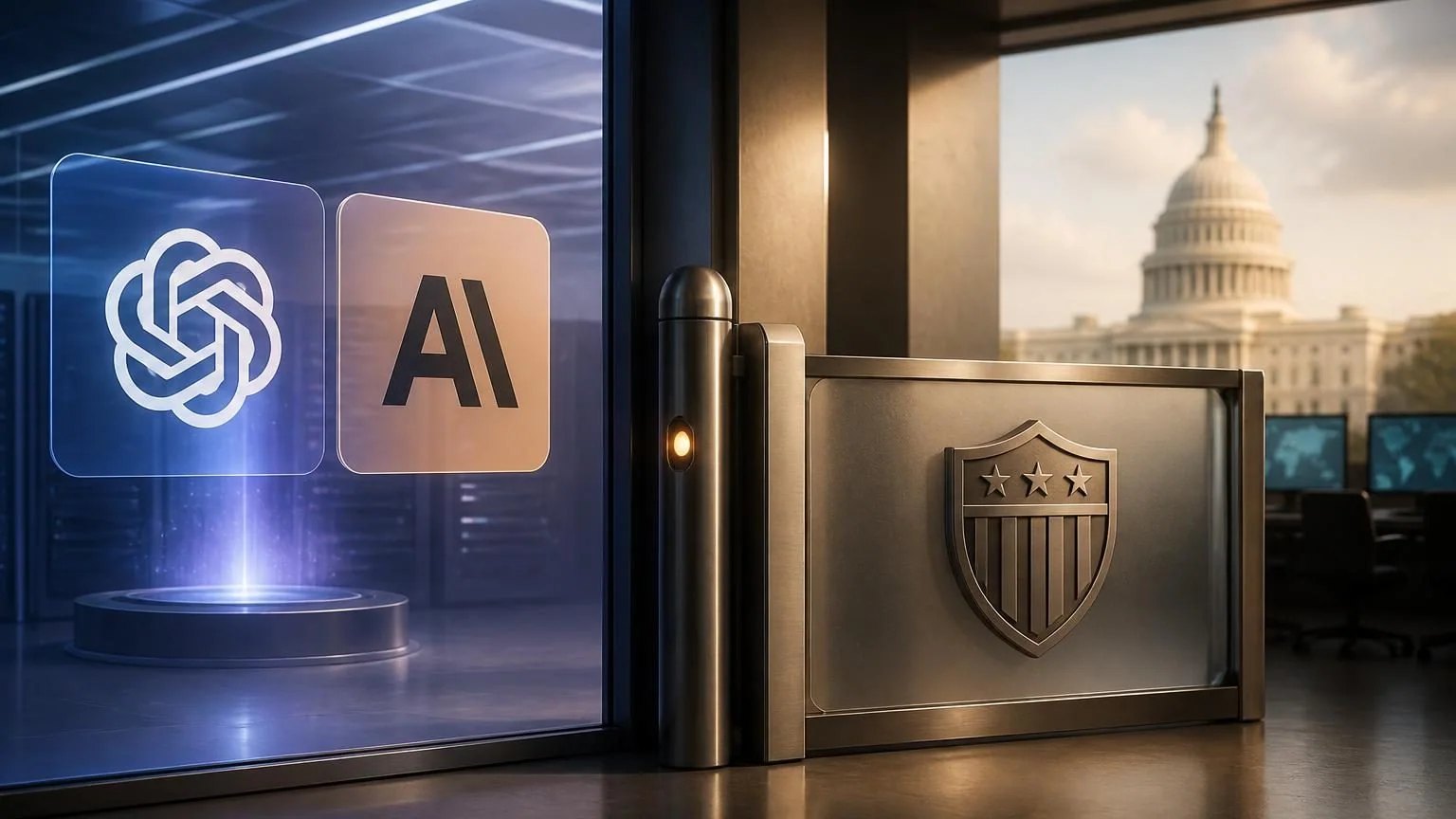
On June 26, 2026, OpenAI said its new GPT-5.6 family—Sol, Terra, and Luna—would start as a limited preview for a small set of trusted partners whose participation had been shared with the U.S. government. That came just two weeks after Anthropic said a June 12 federal directive forced it to disable Fable 5 and Mythos 5 for all customers in order to comply with a foreign-access restriction. By June 26, the government had started allowing Mythos 5 back to some trusted partners.
The important point is bigger than any single model launch. U.S. pressure is starting to change how frontier AI gets rolled out: who sees a model first, which users are eligible, and how much government review happens before a wide release. For businesses building on top of OpenAI, Anthropic, or other frontier labs, that turns model access into a strategic planning issue instead of a pure product-choice issue.
What changed between June 12 and June 26
Anthropic’s June 12 statement described an abrupt government directive to suspend access to Fable 5 and Mythos 5 for any foreign national, including employees. Anthropic said the practical effect was a shutdown for all customers while it worked out how to comply.
Then, on June 26, OpenAI launched GPT-5.6 Sol, Terra, and Luna under its own form of constraint: a limited preview restricted to a small group of trusted partners. OpenAI said those partners had been shared with the government before a broader release planned for later.
That same day, Reuters and other outlets reported that the U.S. government had allowed Anthropic to restore Mythos 5 to some trusted partners as well. In other words, the two highest-profile frontier rollouts of late June both moved through a partner-gated, government-aware access model rather than a normal broad launch.
Why the June 2 executive order matters more now
When the White House issued Executive Order 14409 on June 2, 2026, the language around frontier models could still be read as a framework-building exercise. The order told the government to create a classified benchmarking process for advanced cyber capabilities and envisioned developers giving the federal government access to covered frontier models for up to 30 days before release to other trusted partners.
After the Anthropic and OpenAI episodes, that framework looks much more operational. The U.S. government is not only writing rules in the background. It is already influencing launch sequencing, early-access eligibility, and in Anthropic’s case, temporary withdrawal.
This does not mean every major model will need formal preclearance. But it does suggest that for frontier systems with strong cyber or dual-use potential, the practical rollout pattern may increasingly be: internal evaluations, government visibility, trusted-partner preview, and only later broader access.
What this means for enterprise AI teams
If your company uses frontier models through APIs, copilots, or custom agents, three planning assumptions just changed.
- Launch timelines may be less predictable. A model can be technically ready before it is widely available.
- Access may be segmented. Geography, customer type, employee citizenship, or partner status may affect who can use a model and when.
- Model choice is now a governance question. The best benchmark score may matter less if a provider cannot guarantee stable access for your team or customers.
That is especially important for companies building AI agents into production workflows. If a support bot, coding assistant, research agent, or security workflow depends on one frontier model, policy friction at the model layer can turn into an operational outage or procurement surprise at the product layer.
What smart buyers should do next
Businesses do not need to stop using frontier models. But they do need a more resilient deployment plan.
- Map which workflows truly require the newest frontier model versus a stable generally available model.
- Design fallback paths across vendors or model tiers for critical automations.
- Review whether access rules could create issues for global teams, contractors, or customer-facing deployments.
- Ask vendors how they handle preview programs, government review, and sudden access changes.
The broader signal from June 2026 is clear: frontier AI rollout is becoming a policy-shaped process, not just a product launch calendar. OpenAI and Anthropic may be the first big examples, but they are unlikely to be the last.
What to watch next
The next questions are whether the government clarifies who qualifies as a covered frontier model, how trusted-partner selection works, and whether these constraints stay limited to unusually strong cyber-capable models or spread more broadly across top-tier releases.
If Washington turns June’s improvised controls into a predictable review system, frontier model launches may become slower but easier for enterprises to plan around. If not, businesses should expect more surprise gating, uneven availability, and last-minute rollout changes across the frontier AI stack.