
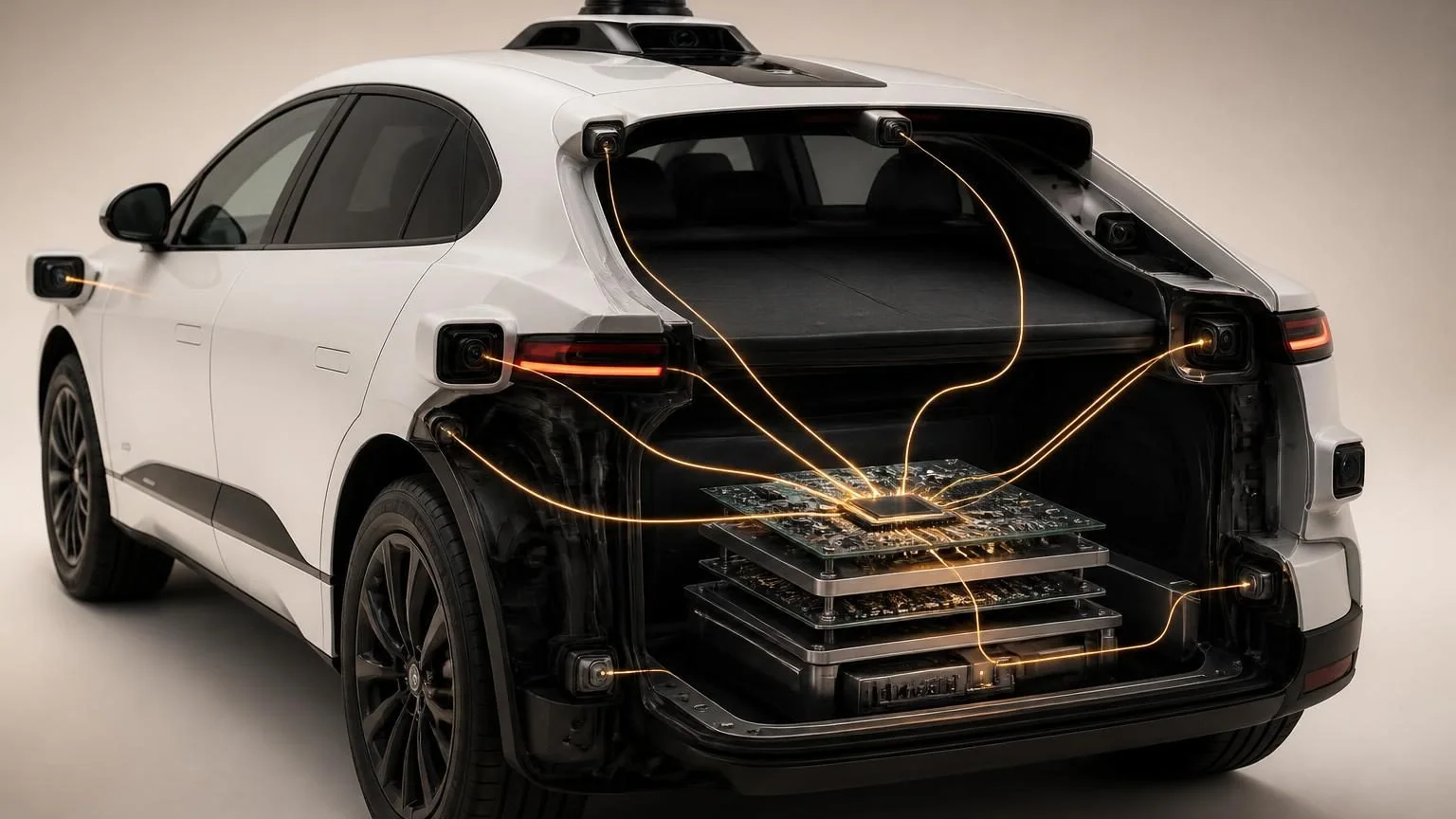
Waymo has offered its clearest look yet at the compute inside the Waymo Driver. The company says its latest onboard architecture includes a purpose-built 5nm ASIC that delivers more than 1,000 TOPS for front-end sensor processing and machine-learning workloads.
That is not simply a chip announcement. It is a reminder that physical AI is constrained by different realities than a cloud chatbot. A robotaxi has to interpret camera, lidar, and radar data, decide on a safe path, and act within milliseconds. It has to do that in heat, vibration, rain, and dense urban traffic, with no human driver ready to take over.
Why custom compute matters
Waymo says it co-designs silicon, sensors, and algorithms so its hardware can process raw sensor data and run neural networks in real time. The new ASIC is specialized for that front-end work, including sensor fusion and low-light perception tasks. Waymo also describes two independent compute engines that can take over if one encounters a fault, plus integration with vehicle liquid cooling.
The practical lesson is that raw model capability is only one layer of an autonomous system. In a vehicle, latency, heat, power use, resilience, and sensor bandwidth are product requirements. A strong model that cannot meet those constraints reliably is not enough.
From cloud AI to edge AI systems
Many organizations first encounter AI through hosted models and APIs. That model is flexible, but physical systems often need a different architecture. Decisions may need to happen locally because connectivity can fail, response times are tight, or sensitive sensor data should remain on the device.
Waymo's disclosure shows the direction of travel for high-stakes edge AI: use general-purpose processors where they fit, then build specialized components for bottlenecks that are central to performance and safety. The company says its architecture remains heterogeneous, pairing its ML technologies with CPUs, GPUs, and accelerators for orchestration, data movement, logging, and inference.
What business leaders should take from this
Most companies do not need to design a 5nm chip. They do need to recognize where their AI workflows meet real operational limits. For a warehouse, factory, field service team, or customer operation, the relevant questions are often simpler: What must happen instantly? What can stay in the cloud? What fails safely if a tool, connection, or model is unavailable?
That is why AI architecture should begin with the workflow, not the model name. Identify the decision loop, the data sources, the required response time, the human approval points, and the fallback path. Then choose the right mix of models, tools, automation, and infrastructure.
The broader signal
Waymo's robotaxis are a visible example of a wider shift. As AI moves into vehicles, machines, and other real-world systems, competitive advantage will increasingly come from system design. The winners will not merely run capable models. They will build dependable loops around them.
For teams planning practical AI deployments, that means treating reliability and orchestration as first-class product features. The intelligence is important. The system that makes it usable is the business.