
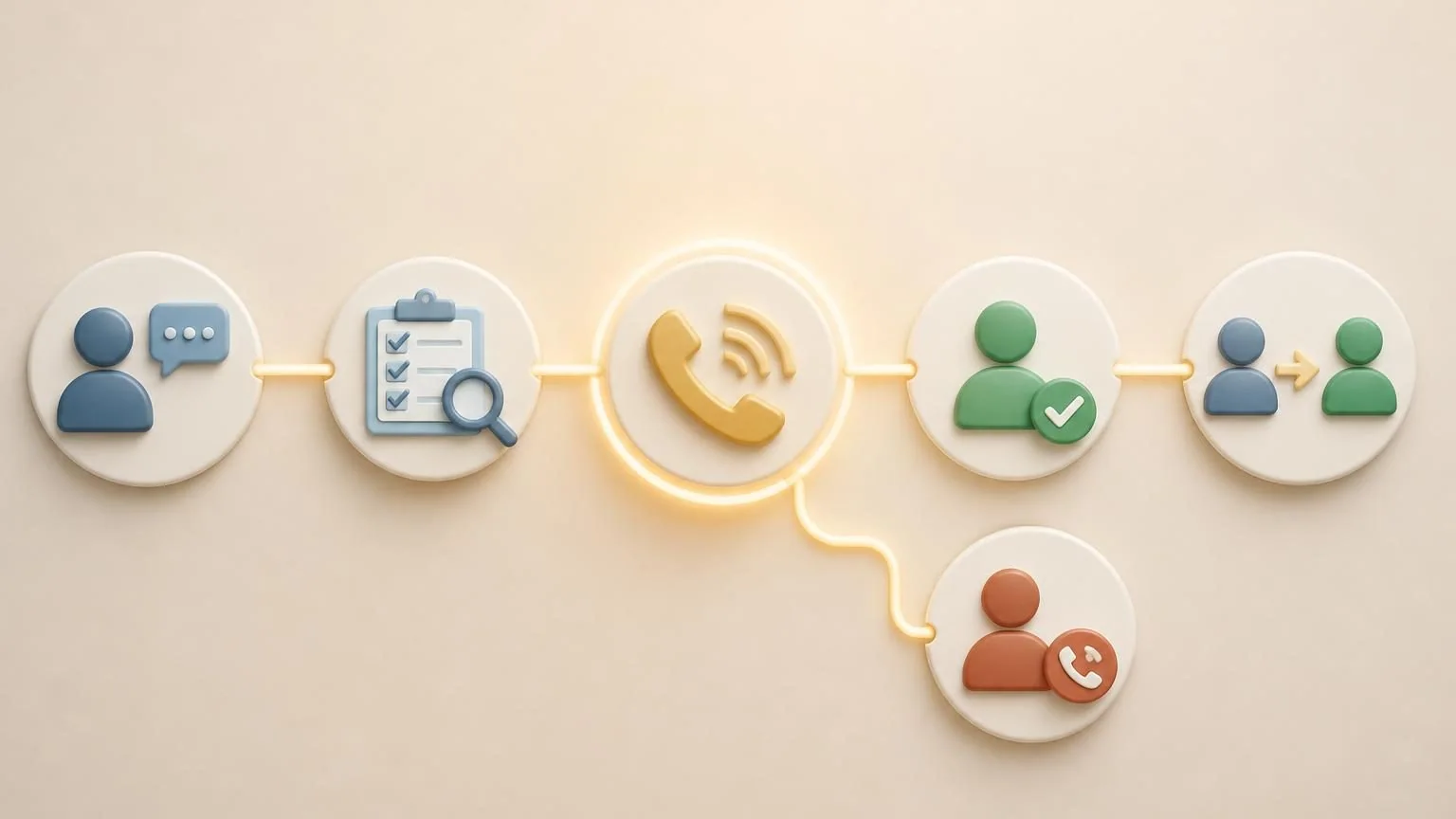
Direct answer: Yes. An AI receptionist can route a caller to a person, department, queue, voicemail, or external number. A cold transfer sends the caller directly; a warm transfer first reaches and briefs the recipient before connecting. The workflow should verify the destination, preserve context, handle no-answer and busy states, and never abandon the caller in a dead end.
Choose routing, cold transfer, or warm transfer deliberately
| Handoff | How it works | Best use |
|---|---|---|
| Direct routing | Intent selects a known queue or extension | Stable departmental calls |
| Cold transfer | Caller is sent without consultation | Low-risk, obvious destination |
| Warm transfer | Recipient answers and receives context first | Leads, sensitive, or complex calls |
| Callback | A task is created with an expectation | No qualified recipient is available |
Warm transfer provides continuity but uses more call legs and can increase wait time and cost. Cold transfer is fast but risks voicemail loops or lost context. Define the choice by call type.
How the telephony connection works
Programmable voice platforms can dial a new destination from an active call or place participants into a conference. Twilio documents conferences as a basis for warm and cold transfers: participants can be held, joined, briefed, and removed programmatically.
The AI model should not directly control unrestricted destinations. Business rules should select an allowlisted person, queue, or number, enforce hours and permissions, and record telephony status events.
Build a warm handoff that carries context
Tell the caller where the call is going and ask them to hold. Reach the recipient, identify the business and caller, summarize the verified reason and collected fields, then connect all parties. The summary should distinguish caller statements from confirmed records.
If private information is involved, share only what the recipient is authorized to receive. Do not announce sensitive details to a shared line, voicemail greeting, or the wrong person.
- Verify the recipient answered before declaring success.
- Give the recipient a way to accept or decline.
- Return to the caller if consultation fails.
- Pass the CRM or ticket reference when available.
Design every failure state
Set explicit behavior for busy, no answer, rejection, invalid number, carrier error, timeout, and disconnect. Recovery may be another qualified queue, voicemail with a structured message, a scheduled callback, or staff alert.
Bound retries and tell the caller what happened. Do not repeatedly dial employees or claim a transfer was completed based only on initiating the outbound leg.
Respect hours, consent, and caller safety
Use current schedules and on-call rules, not a static list that silently becomes stale. Ask before placing a caller on hold or sending them to voicemail, and provide an escape path while waiting.
Emergency, threat, medical, legal, and crisis calls need business-specific policies. An AI receptionist should not improvise professional advice or represent that an employee is available when they are not.
Maintain a trustworthy routing directory
Transfer quality depends on routing data that someone actively owns. Each destination should identify the department or role it serves, supported intents, hours, priority, backup, timeout, voicemail policy, and the date it was last verified. Personal numbers and temporary on-call destinations require tighter access than a public front-desk extension. Remove departed employees promptly instead of relying on the AI to notice repeated failures.
Availability should come from the phone or workforce system when possible. A calendar marked busy is not always the same as unavailable for urgent calls, and a phone presence indicator is not proof that the person is qualified for the request. Keep business qualification rules separate from technical presence, then combine them to choose an allowed destination.
Reporting also needs a stable transfer identifier across the caller leg, consultation leg, conference, queue task, and resulting customer record. Without that relationship, dashboards may count an initiated outbound leg as a successful transfer or count one conversation several times. Reconcile carrier events with the receiving employee or queue outcome before using transfer rates to judge performance.
Review routing changes like production releases. A new extension, office closure, on-call rotation, or department rename can strand active callers even though the AI conversation still sounds normal. Test the affected intents from an external phone, verify both accepted and declined transfers, and retain the prior directory version long enough to diagnose an incident. Give operations a fast way to disable one broken destination without rewriting the entire receptionist.
Measure the handoff, not the transfer attempt
Track correct destination, recipient answer, completed connection, hold time, abandonment, voicemail outcomes, callbacks completed, repeat calls, and routing corrections. Review by intent and destination.
Test simultaneous calls, closed offices, changed extensions, carrier failures, and recipients declining. A transfer feature is production-ready only when failure returns the caller to a useful state.