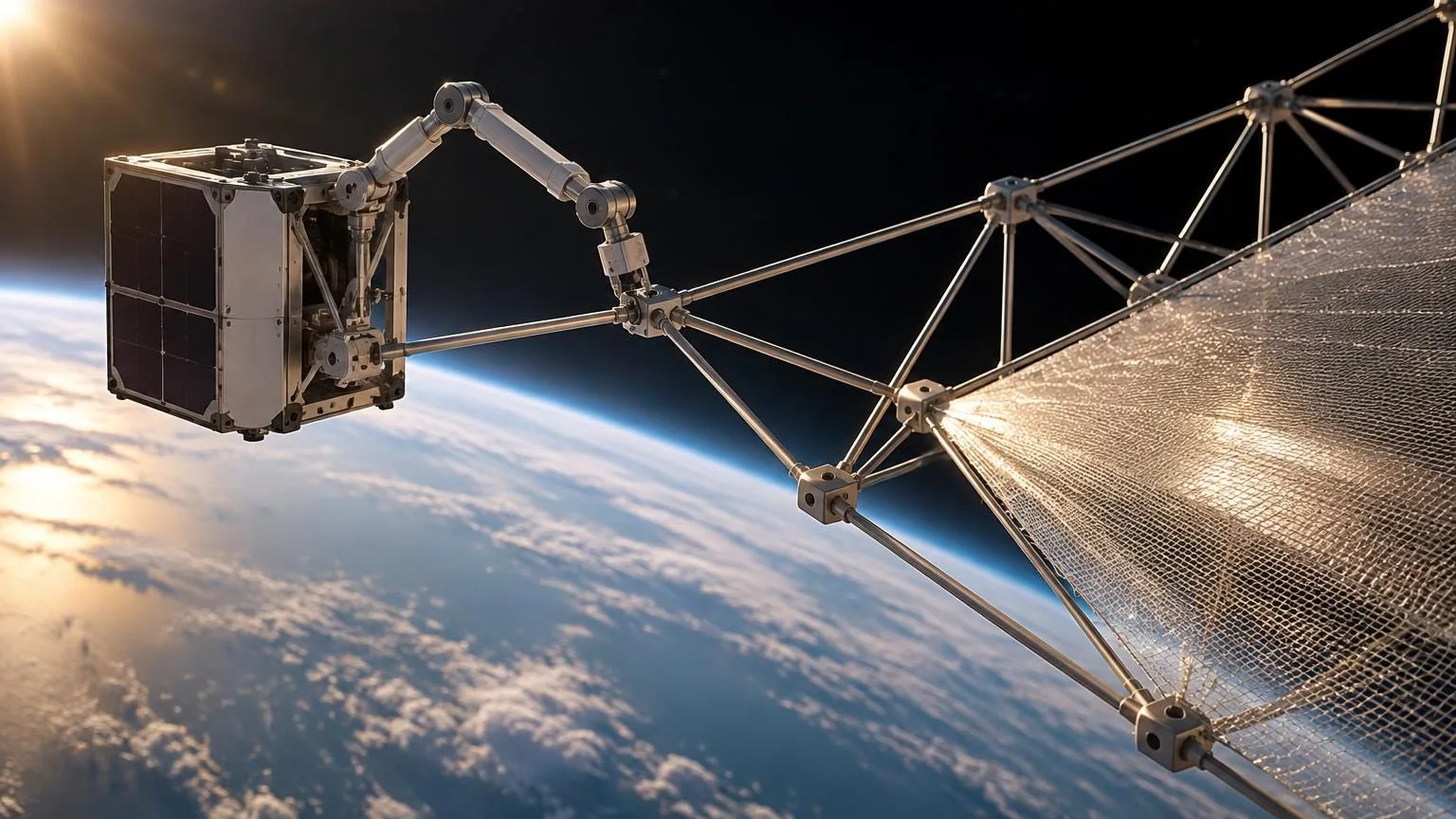
DARPA reported on November 5, 2026 that its NOM4D program had demonstrated automated assembly of a structure in space. A Caltech payload joined composite truss members and deployed reflective mesh in orbit, offering a proof of concept for structures assembled at their operating location.
What the demonstration actually did
The system used a gantry robot moving along three linear axes and custom joints to connect individual members. DARPA describes the result as a way to investigate large, low-mass systems such as antennas. The payload launched on SpaceX’s Transporter-16 mission at the end of March, with Momentus providing hosting and supporting services. November 5 is the dated announcement of the accomplishment, not the launch date.
The NOM4D program’s published objectives address manufacturing, materials, and mass-efficient design for orbital and lunar applications. Its work examines how to move beyond the constraints of packaging an entire finished structure into a launch vehicle.
Why assembly changes the design problem
Our interpretation is that the important shift is in where a design must become complete. A structure that is built before launch needs to survive transport as a finished or folded assembly. A system assembled in orbit instead needs dependable component handling, joint formation, deployment, and verification after arrival.
That creates a different set of engineering questions. A design team would need to establish how it detects a missed connection, what happens when a member is misaligned, and whether the finished geometry can be measured reliably. These questions are useful even at a small prototype scale because they determine what a larger system would have to prove.
A prototype should be judged on repeatable steps
For anyone following commercial space manufacturing, a useful way to read this result is to separate the task into observable operations. Track the supply of parts, the joining process, deployment, and inspection. A repeatable sequence with well-characterized failure conditions is a stronger foundation than a visual impression of scale.
It also helps to distinguish a proposed application from the hardware actually tested. Antennas, solar arrays, depots, and habitats introduce different structural, power, thermal, and certification requirements. Demonstrating one construction method does not resolve every requirement across those applications.
What comes next
DARPA identifies another planned NOM4D milestone involving a University of Illinois Urbana-Champaign experiment on the International Space Station. That project concerns composite-material processing in space, adding a different manufacturing question to the program.
The completed Caltech demonstration provides a specific result for the orbital-assembly discussion. Follow-up evidence about repeatability, dimensional accuracy, resource use, and fault handling will help determine which real structures could benefit from the approach.