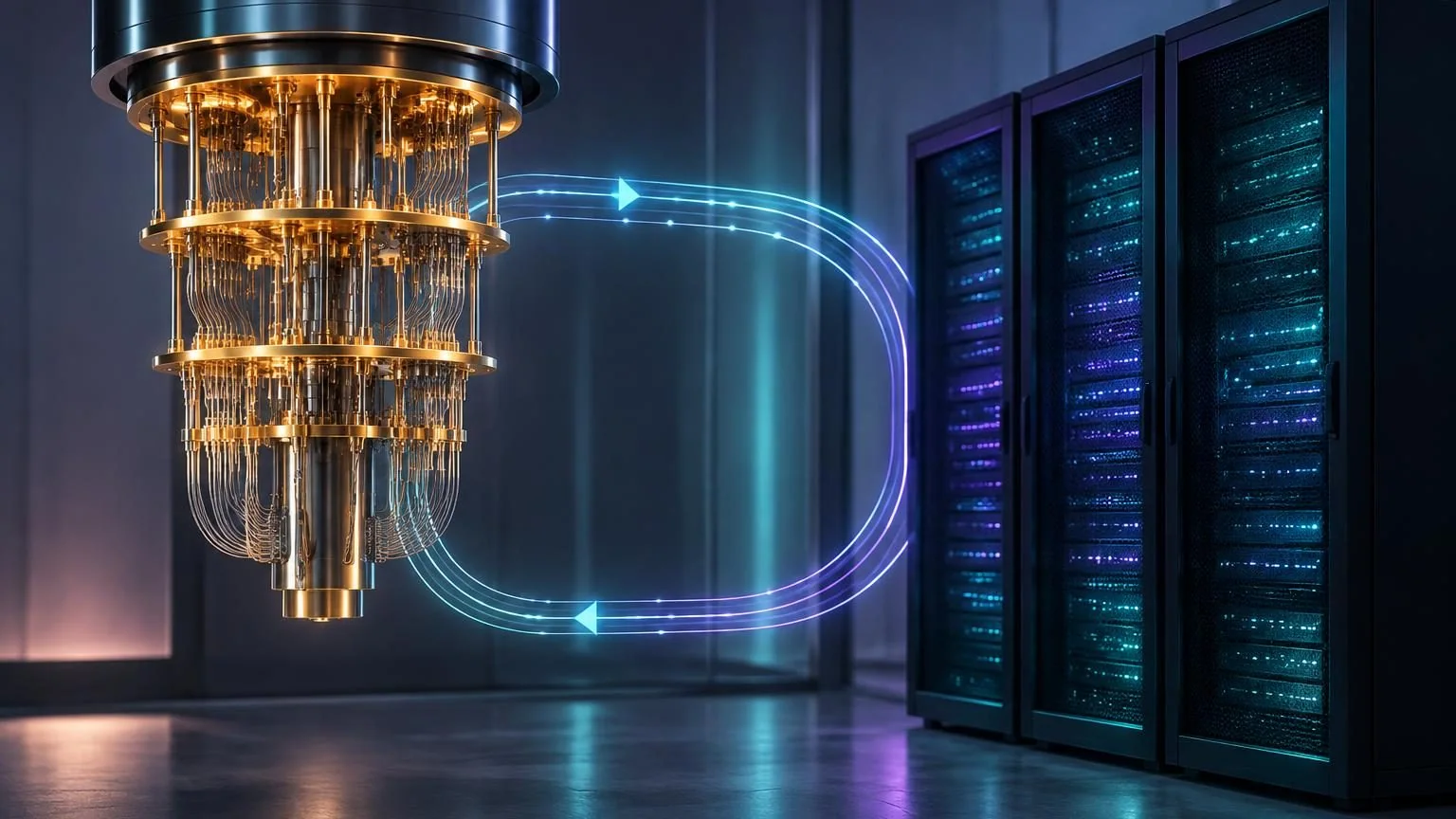
IBM, Oak Ridge National Laboratory, and AMD announced a new co-design platform for quantum error correction on November 5, 2026. The collaboration focuses on the classical computing and orchestration that must work alongside quantum processors. It creates a shared research environment for investigating those requirements.
A combined system for a combined problem
The partners describe a colocated setup bringing IBM quantum computers together with Oak Ridge’s Umbra high-performance computing system. AMD identifies the 120-qubit IBM Quantum Nighthawk among the quantum systems and says Umbra uses AMD Instinct MI355X GPUs and fifth-generation EPYC CPUs.
IBM’s announcement places the effort in the development of error-corrected quantum computing. AMD’s account explains the division of work across control, readout and decoding, parallel calculations, and orchestration. The announcement concerns a research platform and integration effort, with future connections to larger Oak Ridge computing resources also planned.
Why classical infrastructure belongs in the quantum story
Our reading is that the announcement shifts attention from a quantum processor viewed alone to a complete operating system for experiments. A useful result depends on how measurements are interpreted, how the next operation is selected, and how timing and software behavior are coordinated across equipment.
That makes co-design a practical discipline. Different teams need common assumptions about interfaces, workload traces, validation, and failure conditions. A shared environment gives researchers a place to examine the consequences of those assumptions instead of treating each subsystem as an independent black box.
What an enterprise research team should ask
For an organization evaluating quantum-related research, the first question is the problem being tested. Define the scientific or engineering hypothesis and specify which measurements would support it. An experiment can be valuable even when it addresses only one part of a much larger fault-tolerance goal.
The next question is reproducibility. Record the quantum hardware, classical software, calibration context, and data-processing steps involved in a result. Check whether an improvement comes from a changed algorithm, a different machine, or a modified evaluation procedure. Those distinctions matter when deciding whether work can be repeated elsewhere.
A third question concerns access and collaboration. A joint institutional platform does not automatically establish a generally available cloud service for outside customers. Teams should confirm participation routes, supported experiments, and data-handling terms with the operators before making their own project commitments.
The next evidence that matters
Useful follow-up should show specific error-correction experiments, documented integration methods, and measurements that explain the classical resources required. Those results can help the wider community understand where system costs and timing constraints arise.
The November announcement establishes a concrete collaboration around a difficult infrastructure problem. It gives researchers a place to test how quantum and classical resources behave together, while the broader objective of scientifically useful, error-corrected quantum computing remains work in progress.