
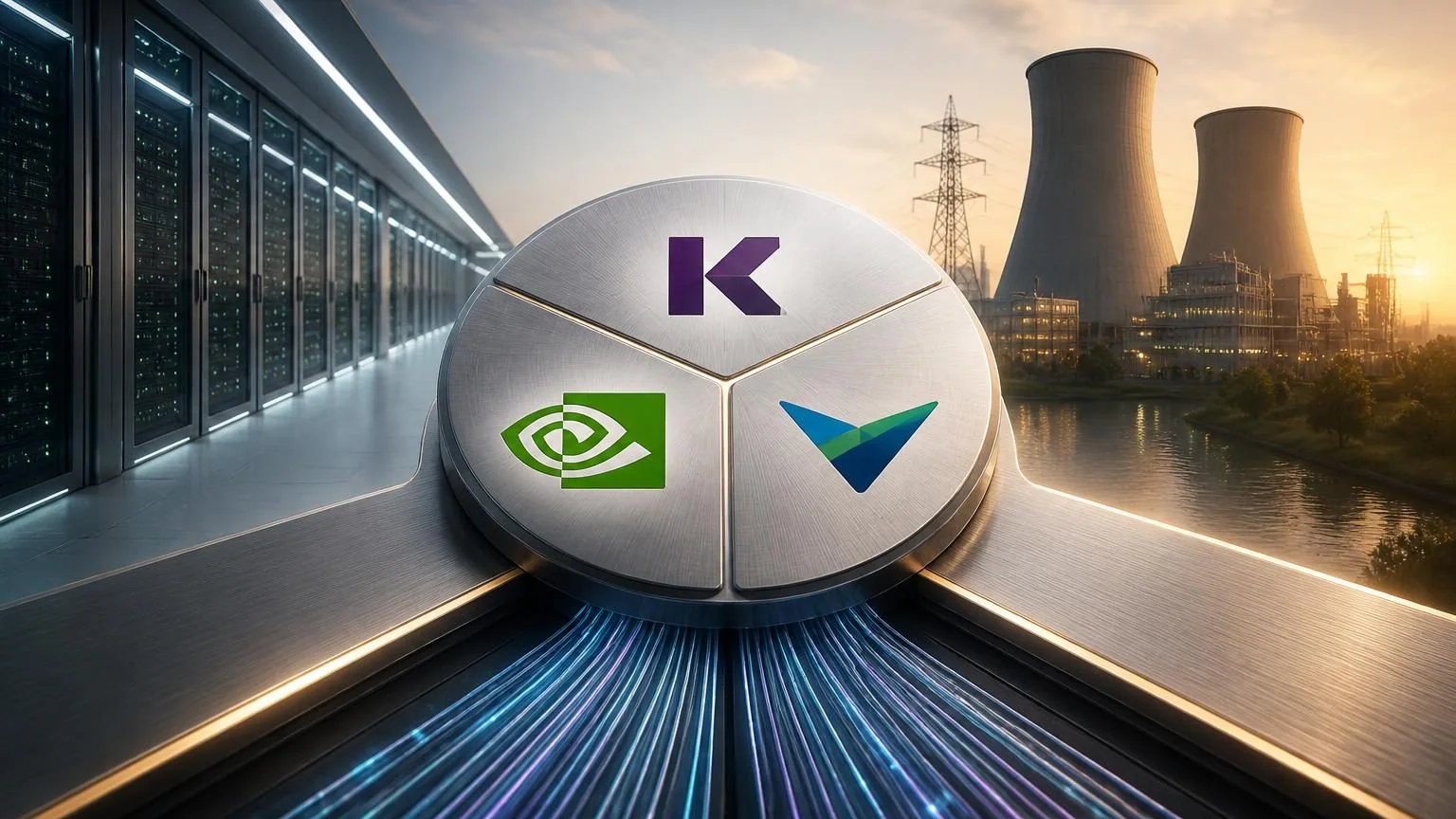
On June 11, 2026, KKR, the Kuwait Investment Authority, Nvidia, and Vistra launched Helix Digital Infrastructure with more than $10 billion in committed capital and named former Amazon Web Services CEO Adam Selipsky as co-founder and CEO. The new company is designed to finance, build, and coordinate the data centers, power, transmission, and connectivity that hyperscalers need as AI demand keeps climbing.
The immediate headline is the size of the launch, but the more important signal is structural. Helix is trying to package the hardest parts of AI expansion into one delivery model: long-duration capital, hyperscale data center development, electricity access, grid coordination, and fiber connectivity. That makes this less like a normal infrastructure fund announcement and more like a bid to become a control point in the physical buildout behind frontier AI.
What launched on June 11
Helix starts with over $10 billion of committed capital from founding investors including KKR, KIA, Nvidia, and Vistra. KKR said the company will act as a single coordination point for hyperscalers that need integrated support across data centers, power, connectivity, and related infrastructure.
- Adam Selipsky will lead the company after previously running AWS.
- Nvidia will serve as a strategic partner tied to its DSX AI factory infrastructure.
- Vistra will be the preferred power partner for Helix investments.
- Helix plans to invest across hyperscale data center development, power generation, transmission and distribution, and fiber infrastructure.
That combination matters because AI infrastructure is no longer only a compute procurement story. It is a sequencing story: who can secure land, power, interconnection, financing, equipment, and operational execution fast enough to keep up with model and cloud demand.
Why this matters more than another infrastructure fund headline
Helix is arriving at a moment when the AI boom is running into more physical constraints. The pressure points are increasingly outside the model layer: electricity supply, interconnection queues, component availability, and the difficulty of coordinating multiple counterparties on one build. KKR’s pitch is that hyperscalers want fewer moving parts and more repeatable execution as projects get larger and more time-sensitive.
That is why the Selipsky detail matters. Hiring a former AWS chief signals that Helix is not positioning itself as a passive capital provider. It is trying to speak directly to hyperscaler operating needs from the inside, with leadership that understands how cloud buyers think about capacity, deployment timing, and scale risk.
The investor mix also sharpens the message. Nvidia brings technical credibility around AI factory design, while Vistra brings immediate relevance on power, which is now one of the hardest gating factors in AI expansion. Semafor also framed the launch as part of a broader Gulf capital push into global AI infrastructure, adding a geopolitical layer to what might otherwise look like a straightforward private-markets story.
Business impact for the AI infrastructure market
For hyperscalers and frontier model providers, the appeal is obvious: one partner that can help line up capital, data center development, electricity, and connectivity could shorten deployment timelines and reduce coordination risk. If Helix executes, it could become a template for how AI infrastructure gets financed and assembled over the next phase of the buildout.
For enterprises, the practical impact is more indirect but still important. Large infrastructure vehicles like Helix can influence where AI capacity comes online first, how quickly prices normalize, and which regions get better access to high-performance compute. That affects cloud economics, deployment timelines, and the feasibility of more agent-heavy workloads.
It also reinforces a bigger market shift: AI infrastructure is becoming a bundled systems business. The differentiator is moving from who has access to chips alone to who can combine chips, energy, connectivity, financing, and project execution into something customers can actually deploy.
What to watch next
The first test is whether Helix can turn its launch structure into real projects at speed. The market will be watching for signed hyperscaler relationships, additional institutional backers, and concrete buildouts that show the company can translate its integrated model into delivered capacity.
The second test is power. Vistra’s preferred-partner role is strategically important because near-term electricity access is one of the hardest constraints in AI infrastructure. If Helix can convert existing generation relationships into faster deployment, that could matter as much as its capital base.
The third test is whether this model spreads. If more infrastructure investors copy the Helix structure, the AI market may start rewarding firms that can coordinate physical deployment end to end, not just fund one piece of the stack.
For AI agents, automation, and enterprise AI teams, the takeaway is simple: the next competitive bottleneck is increasingly physical. Model quality still matters, but the ability to secure reliable compute, power, and rollout capacity is becoming part of the product.