
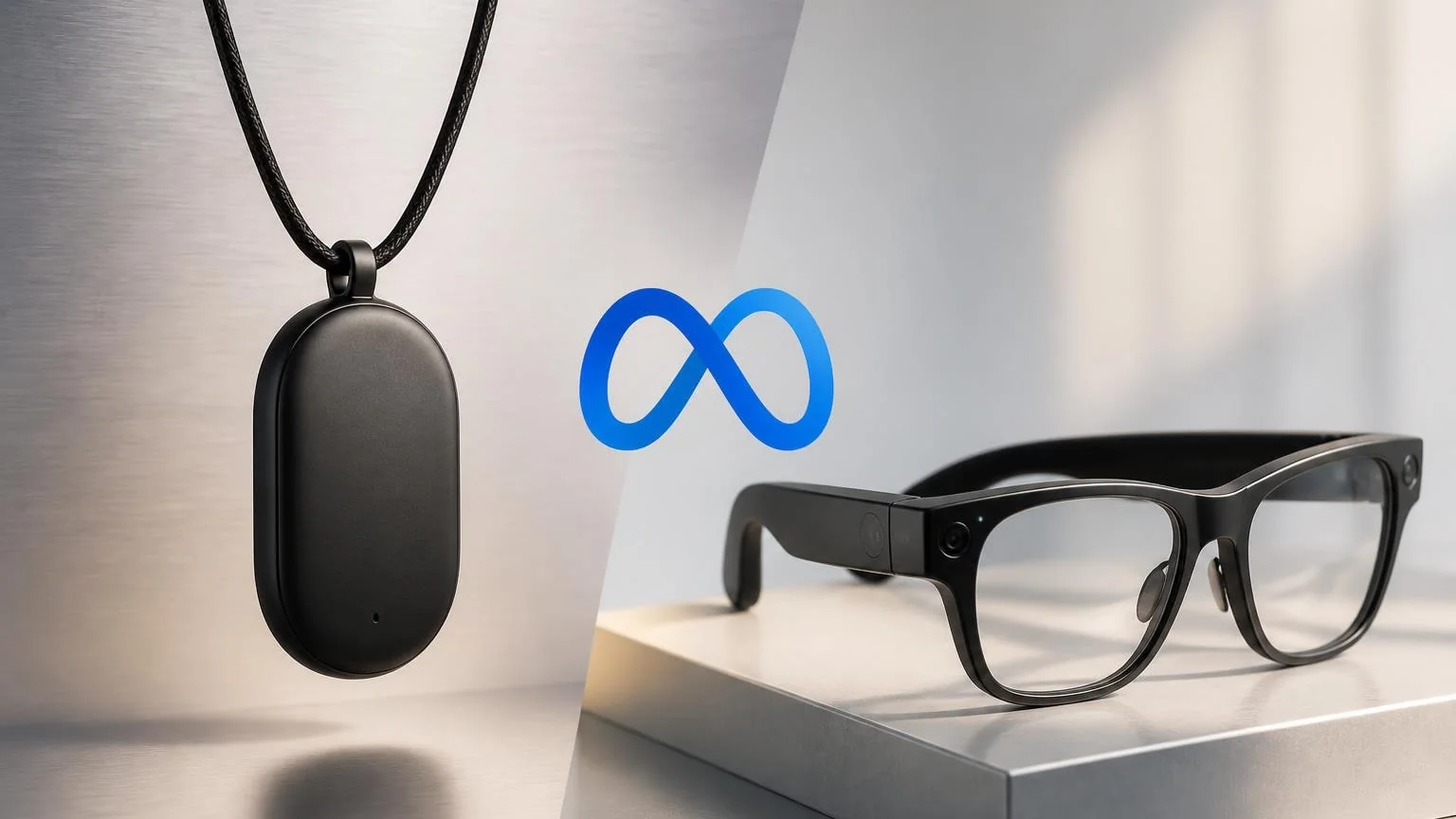
On May 30, 2026, Reuters and TechCrunch reported that Meta is planning to test an AI pendant within the next year and add a business-focused offering called Wearables for Work, based on a memo first reported by The Information. The reported roadmap also points to a broader expansion of Meta’s AI glasses lineup, making this less about one new gadget and more about how Meta wants AI to reach people during the workday.
If the report holds, Meta is trying to turn wearables into a new interface layer for AI assistants: something more ambient than a phone, less immersive than a headset, and more persistent than a chat window. That matters because enterprise AI buyers are increasingly less interested in flashy demos and more interested in interfaces that fit into real work.
What Meta reportedly plans next
According to the May 30 reporting, Meta wants to internally test an AI pendant in the next year, expand its smart-glasses portfolio, and package some of that push into a workplace-oriented software offer. Reuters said the memo described a service called Wearables for Work, while TechCrunch connected the pendant idea to Meta’s 2025 acquisition of Limitless, the startup behind a conversation-capturing pendant device.
The hardware context is already in place. Meta has existing wearable partnerships with EssilorLuxottica through Ray-Ban and Oakley smart glasses. Separately, Meta has officially said that its Muse Spark model powers Meta AI and is rolling out across the Meta AI app, website, and AI glasses. Put together, the reported pendant plan looks like an attempt to widen the hardware surfaces through which Meta AI can observe context, answer questions, and eventually trigger actions.
Why the enterprise angle matters more than the pendant
The most important part of this story is not the necklace form factor. It is the workplace packaging. A consumer AI pendant can look like another risky wearable experiment. A business-facing wearable subscription suggests Meta thinks companies may pay for hands-free access to search, memory, summarization, communications, and guided task support if the workflow fit is clear enough.
That is a much more commercially useful framing. In warehouses, field service, retail floors, healthcare admin environments, and mobile sales or support roles, the friction is often not model quality alone. It is whether the worker can use AI without constantly stopping to open a laptop or phone. Wearables promise a more continuous surface for retrieval, prompts, reminders, translation, documentation, and lightweight task execution.
They also create a different kind of enterprise software question. Once AI is always available in the worker’s field of view or clipped to their body, buyers have to think about privacy, recording consent, retention, identity, escalation rules, and where automated action should stop. In other words, the interface gets more natural, but governance gets harder.
Business impact for AI agents and automation teams
Meta’s reported move lands at a moment when AI agent builders are trying to escape the browser tab. The next competitive fight is increasingly about where agents live during normal work: inside desktops, meetings, messaging apps, developer tools, phones, and now wearables.
For automation teams, a wearable AI layer could be useful in three specific ways:
- Continuous context capture: workers could pull in ambient information, recent conversations, location context, or live visual context without re-entering everything into a prompt.
- Faster task initiation: voice- or glance-based triggers could start workflows, fetch instructions, summarize interactions, or route requests without breaking the work surface.
- Better last-mile guidance: AI could support frontline and mobile workers in moments where desktop copilots are too slow or too distant from the action.
But this will only matter if the product avoids the mistakes that hurt earlier AI hardware. Workers and enterprises will care less about novelty than about accuracy, battery life, permissioning, discreet UX, and whether the system can connect to real business tools. If wearable AI becomes another transcription toy, it will stay niche. If it becomes a governed execution and support layer, it becomes strategically more important.
What to watch next
The immediate watch items are straightforward. First, whether Meta confirms any part of the reported roadmap. Second, whether Wearables for Work emerges as a real software and admin layer rather than a packaging concept. Third, whether Meta positions wearables as simple access points to Meta AI or as more agentic systems that can remember, recommend, and act.
Meta’s financial backdrop raises the stakes. In its first-quarter 2026 results, Reality Labs posted just $402 million in revenue and a $4.028 billion operating loss. That makes the wearables push more than a product experiment. Meta needs a more convincing path from AI hardware mindshare to recurring software usage and, eventually, enterprise revenue.
For AI agents and automation teams, this is the practical takeaway: the next agent interface may not look like another chat app. It may look like a wearable tied to a governed workflow, with AI available in the moment work actually happens. Whether Meta can make that useful is still unproven, but the direction is clear.