
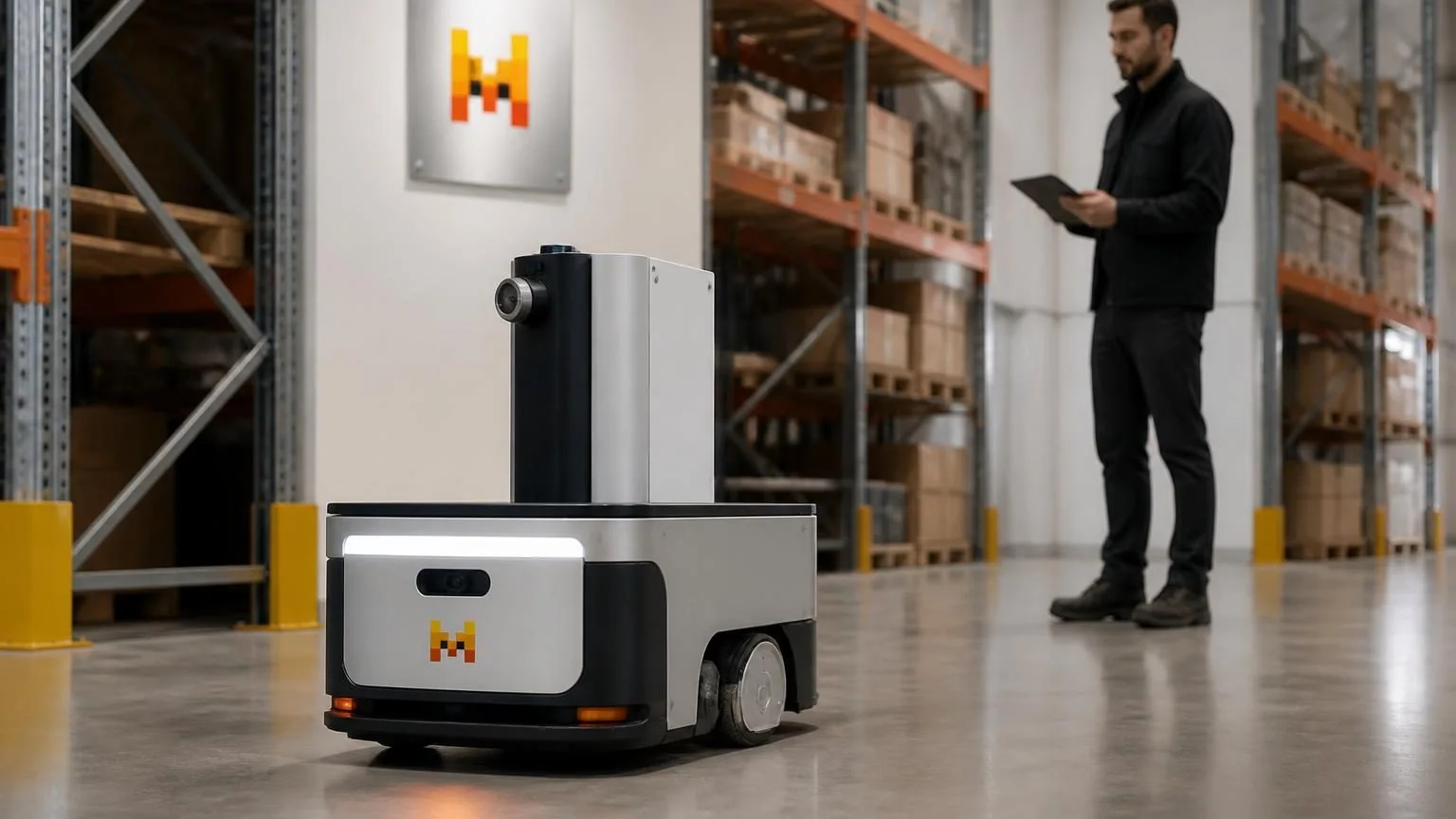
Mistral has joined the physical AI conversation with a model that is more concrete than the hype around “robots that can do everything.” On July 8, 2026, the company introduced Robostral Navigate, an 8B model built for embodied navigation that uses a single RGB camera instead of LiDAR or multi-camera sensor stacks. Mistral says the system reached 76.6% success on unseen R2R-CE benchmarks and is designed to work across different robot suppliers and form factors.
That combination matters because it points to a simpler route from research demo to operational deployment. If navigation can be handled with fewer sensors and less integration overhead, the first commercial wins in physical AI may arrive in warehouses, factories, and service environments where moving safely through space is a bigger bottleneck than object manipulation.
What Mistral actually launched
Robostral Navigate is not a general-purpose humanoid brain. It is a focused navigation model that takes a plain-language instruction and a camera view, then predicts how a robot should move through an environment. Mistral says the model was trained entirely in simulation, built in-house, and optimized with token-efficient techniques and reinforcement learning.
The practical takeaway is that Mistral is not trying to win the entire robotics stack in one step. It is starting with a capability that industrial users can understand: getting a machine from point A to point B in spaces full of people, shelves, corridors, and obstacles.
Why the single-camera approach matters
Most robotics systems lean on more expensive sensing setups, including depth sensors, LiDAR, and multiple cameras. Mistral is explicitly arguing that navigation does not need that much hardware to become useful. The company says Robostral Navigate can operate with one ordinary RGB camera and no depth sensors while still outperforming stronger single-camera approaches on its benchmark.
That has business consequences. Lower sensor complexity can reduce cost, simplify retrofits, and make fleets easier to standardize across robot vendors. For operations leaders, it also makes pilot planning less about exotic hardware and more about whether the workflow is repeatable, safe, and worth automating first.
What this means for factories and warehouses
The launch is important not because it solves robotics end to end, but because it narrows the gap between AI software and physical operations. Navigation is one of the hardest practical problems in production environments, and it is often the first one that companies need before they can scale autonomous movement.
Mistral’s own manufacturing page frames the broader strategy around physics AI, connected workflows, and industrial-grade control. That lines up with the company’s earlier move into industrial AI through Emmi AI and its push to combine models, simulations, and workflow tooling for engineering-heavy customers. In other words, Robostral Navigate looks less like a standalone product and more like another layer in a larger industrial stack.
What business teams should watch next
The biggest question is whether this remains a navigation-first system or becomes part of a broader embodied AI platform. If Mistral can keep improving simulation-trained navigation while connecting it to workflow orchestration, the next wave of adoption may start with guided movement, inspection, and transport before it reaches manipulation and task completion.
For enterprises, the right response is not to buy every robotics headline. It is to identify where physical AI can remove friction in real operations, then decide whether the best first step is navigation, routing, monitoring, or a broader automation rollout. In many companies, that prioritization will matter more than the model itself.