
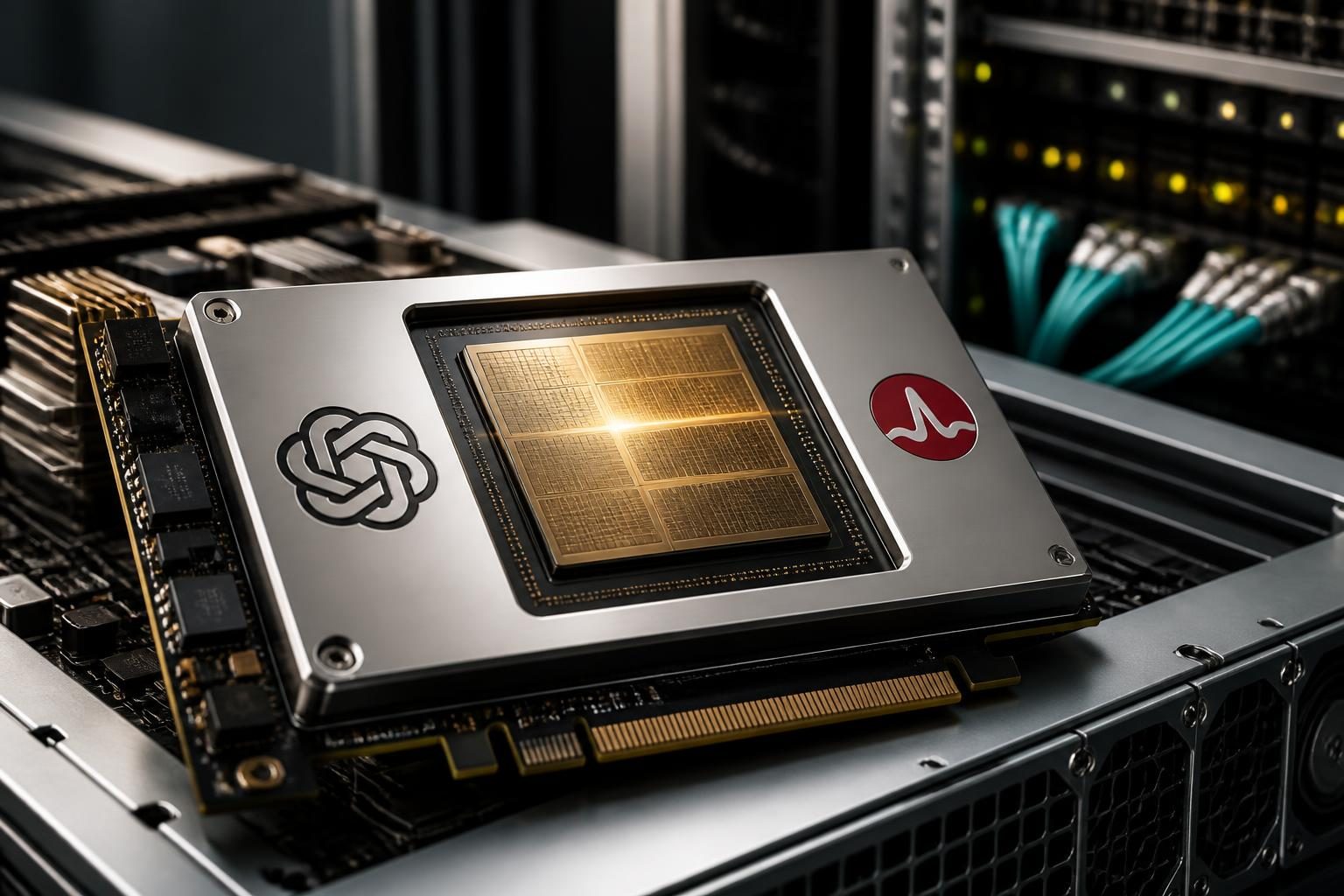
On June 24, 2026, OpenAI and Broadcom unveiled Jalapeño, OpenAI’s first custom AI inference chip. That may sound like a supplier story, but it is really a product story: if OpenAI can make inference cheaper, faster, and more reliable, that advantage can flow directly into ChatGPT, Codex, API usage, and future AI agents.
The bigger takeaway is that the frontier AI race is no longer just about who has the smartest model. It is increasingly about who controls more of the stack beneath the model: silicon, networking, systems, and deployment economics. Jalapeño is OpenAI’s clearest move yet in that direction.
What OpenAI actually announced
OpenAI describes Jalapeño as its first “Intelligence Processor,” built specifically for large language model inference rather than as a general-purpose accelerator adapted to AI later. The company says the chip was co-developed with Broadcom, with Celestica helping on board, rack, and system integration.
According to OpenAI, engineering samples are already running machine-learning workloads at production target frequency and power, including GPT‑5.3‑Codex‑Spark. OpenAI also says early testing shows performance per watt substantially better than current state-of-the-art systems, although a fuller technical report is still to come.
- It was unveiled on June 24, 2026.
- OpenAI says the chip went from design to production in nine months.
- The design is focused on LLM inference, where latency, throughput, memory movement, and serving efficiency matter most.
- OpenAI says initial deployment is planned by the end of 2026, with a broader multi-generation platform to follow.
That last point matters. This is not being presented as a side project or lab experiment. OpenAI is positioning Jalapeño as the first step in a longer infrastructure roadmap.
Why this is bigger than a single chip launch
OpenAI’s June 24 announcement fits into a much broader infrastructure strategy. Back on October 13, 2025, OpenAI and Broadcom announced a 10-gigawatt collaboration for custom AI accelerators, with deployment targeted to begin in the second half of 2026 and continue through 2029. Jalapeño is the clearest public proof that the plan is moving from partnership language to actual silicon.
Just as important, OpenAI has been explicit that this is not an overnight replacement for NVIDIA. In its March 31, 2026 funding announcement, OpenAI said NVIDIA remains the foundation of its infrastructure while the company expands to a broader portfolio across multiple cloud partners and multiple chip platforms, including its own chip with Broadcom.
That nuance is easy to miss, but it is the real signal. The market is moving toward multi-chip AI infrastructure, where frontier labs mix GPUs, custom accelerators, specialized inference systems, and different cloud footprints depending on the workload. For OpenAI, Jalapeño is about gaining tighter control over one of the most important layers in that stack: inference.
Inference is where AI actually reaches users. Training determines what a model can do, but inference determines whether businesses can afford to use that capability at scale. Faster and cheaper inference can mean more responsive support bots, more dependable background agents, lower API serving costs, and better economics for software teams trying to turn AI from a demo into an operational system.
Why inference economics matter so much for AI agents
This is where the announcement becomes especially relevant for business AI buyers and agent builders. Agent workflows are rarely a single prompt and a single answer. They tend to involve repeated tool calls, retries, memory lookups, orchestration steps, code execution, and long-running background work. In those environments, cost per task and response reliability can matter as much as raw model intelligence.
OpenAI’s own framing reflects that. The company says improvements in cost, speed, and reliability can show up as faster ChatGPT answers, Codex tasks that take more steps with less waiting, and API products that become cheaper and more dependable to build on. That is exactly the kind of systems-level improvement that can change enterprise adoption curves.
If that promise holds up in production, the companies that benefit most may not be the ones chasing the most impressive benchmark headline. They may be the ones that can serve useful agent workflows at a better cost-performance point, with fewer outages and less latency under real demand.
That is also why custom silicon is becoming strategic. The winners in enterprise AI may not be the vendors with the most components. They may be the ones that can make models, infrastructure, and products reinforce each other in one efficient operating loop.
What enterprise teams should watch next
Most businesses are not going to buy Jalapeño hardware directly this year. But they should pay attention to what happens next, because it will shape the AI platforms they do buy from.
1. Real-world performance evidence
OpenAI has said early testing looks strong, especially on performance per watt, but the market will want detailed benchmarks and production-level evidence. That matters more than launch-day positioning.
2. Whether benefits show up in products
The real test is not whether OpenAI can unveil a chip. It is whether the chip leads to better product economics in ChatGPT, Codex, and the API: faster responses, stronger reliability, or lower delivery cost over time.
3. How fast multi-chip strategies become normal
OpenAI’s own infrastructure posts make clear that the future is not one vendor, one chip, or one cloud. Enterprise teams planning AI roadmaps should expect a more fragmented but more optimized market, where workload design and vendor fit matter more than ever.
4. What it means for agent deployment decisions
If you are evaluating AI agents for support, internal operations, research, or workflow automation, this announcement is a reminder to ask better questions. Not just which model looks smartest in a demo, but which platform can sustain your workload with the right mix of speed, reliability, governance, and cost.
The headline here is not simply that OpenAI now has a chip. It is that inference has become a first-class competitive layer. And for enterprises building AI agents, that may matter more than the chip itself.