
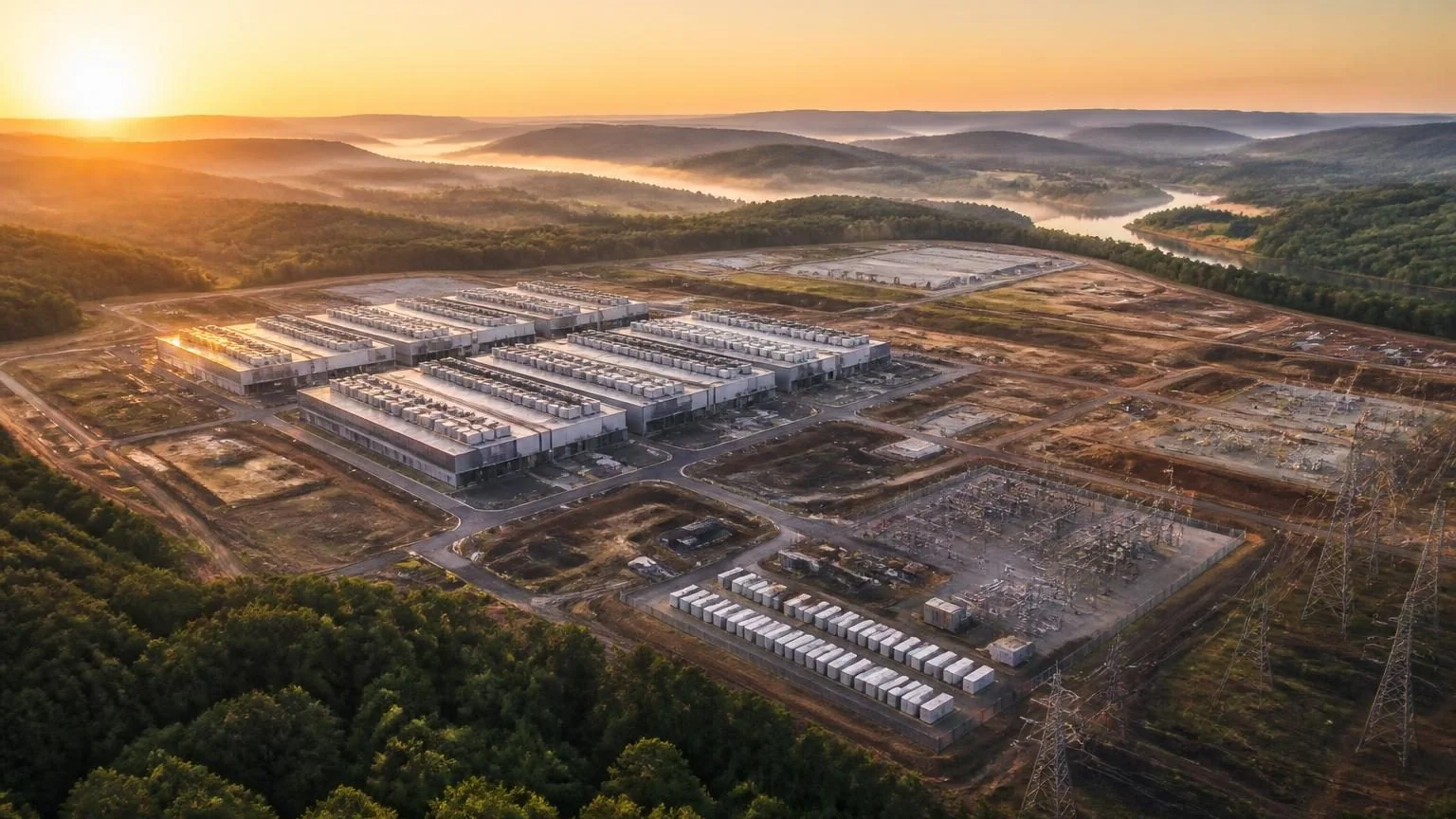
OpenAI has entered an agreement to secure approximately 8 gigawatts of IT capacity at the PORTS-Pike Technology Campus in Pike County, Ohio. The site will exclusively host NVIDIA AI compute infrastructure, according to OpenAI.
The announcement is a useful marker of where the AI race is moving. The limiting factor is increasingly not just which company has the most capable model. It is whether a company can secure enough land, generation, transmission, cooling, construction capacity, and community support to run that model at scale.
A capacity agreement, not just another data center announcement
The PORTS-Pike project sits within a larger redevelopment of the former Portsmouth Gaseous Diffusion Plant site. In March, the U.S. Department of Energy said SB Energy planned a 10 GW data center development there, supported by 10 GW of new power generation, including 9.2 GW of natural gas generation, plus new transmission infrastructure.
OpenAI is now becoming a committed customer for a major portion of that planned compute. Its August 17 announcement also described a proposed six-year buildout through 2032, community investment, and Codex credits for Ohio college students.
Why power has become an AI product decision
For enterprises, model choice often looks like a software decision. At frontier scale, it is an infrastructure decision. Compute availability determines where capacity can be deployed, how quickly workloads can grow, and which tradeoffs are made around reliability, cost, and energy sourcing.
That is why agreements like PORTS-Pike matter beyond Ohio. They show AI providers planning years ahead for physical capacity rather than treating cloud supply as an interchangeable utility.
What leaders should watch
Projects of this size create real execution questions. Construction schedules, generation and transmission delivery, water use, permitting, and community commitments all affect whether announced capacity becomes usable capacity. The important signal is not simply the headline gigawatt figure. It is the chain of dependencies needed to turn that figure into dependable computing.
For companies deploying AI today, the near-term takeaway is more practical: build workflows that can work across providers, measure the business value of each workload, and avoid assuming cheap, abundant compute will be permanently available on demand.
The broader shift
AI infrastructure is becoming regional industrial policy in real time. OpenAI's PORTS-Pike agreement links a frontier AI company, a former federal industrial site, power development, and workforce promises in one project. The next phase of the AI economy will be built as much with substations and construction crews as with model releases.