
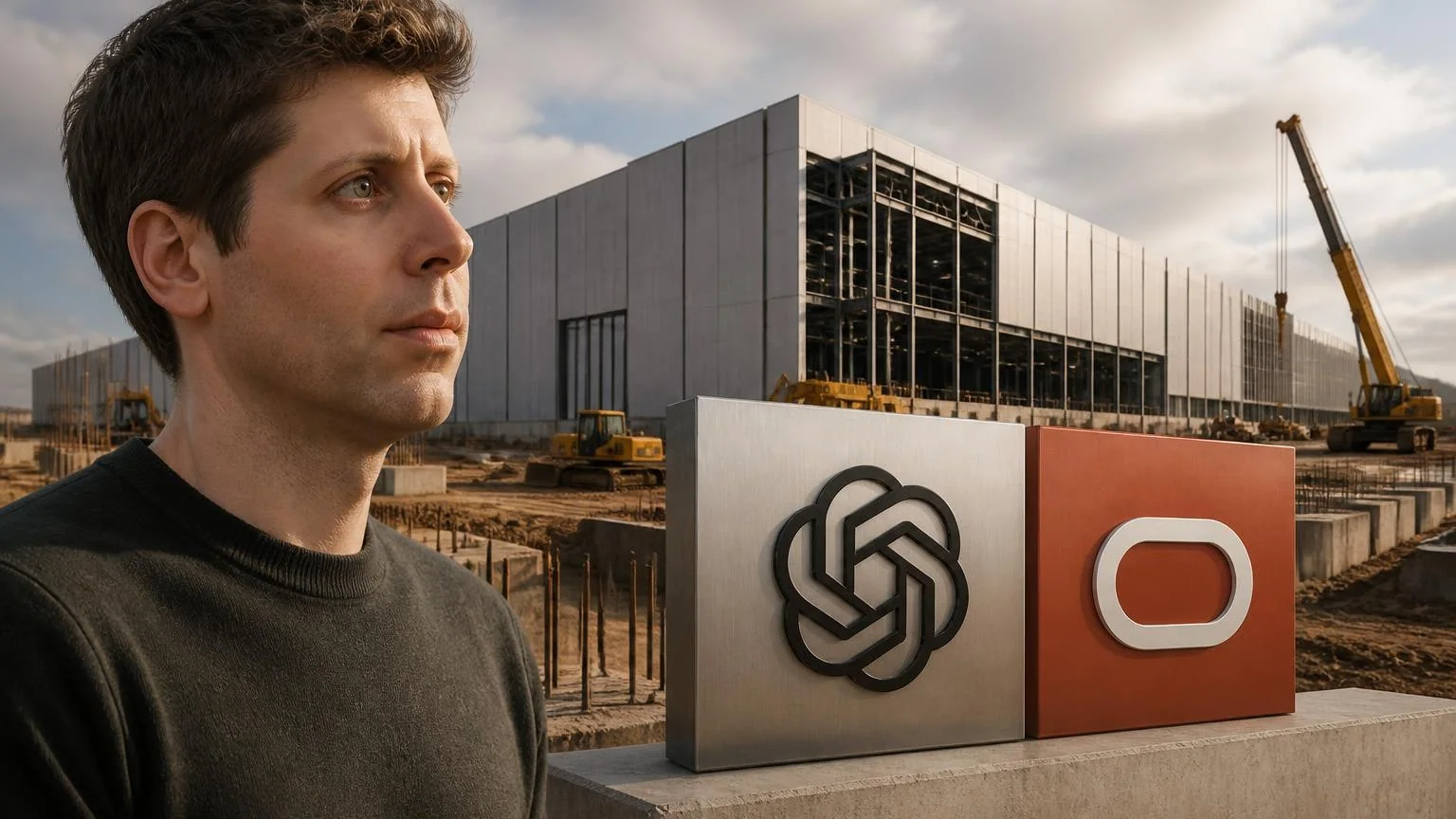
On June 1, 2026, OpenAI said it broke ground on The Barn, a 1-gigawatt data center campus in Saline, Michigan, alongside Governor Gretchen Whitmer and partners Oracle, Related Digital, and Walbridge. The move turns Stargate from a long-range infrastructure plan into a live construction story, and it gives OpenAI a far more physical answer to rising demand for enterprise AI, coding systems, and agent workloads.
OpenAI said the Michigan site will be part of its Stargate program and framed the campus as infrastructure meant to make advanced AI more useful, reliable, and available over time. The company also paired the groundbreaking with specific local commitments: no project infrastructure costs passed to local ratepayers, a closed-loop cooling design it says uses about as much water as a typical office building, more than 2,500 union construction jobs, 450 permanent onsite jobs, 1,500 county-wide jobs, a projected $1 billion in tax revenue over the lease term, and up to $45 million in Codex credits for eligible Michigan college, community college, and trade school students during the 2026–2027 academic year.
What actually broke ground in Michigan
The June 1 event was not a vague memorandum or future-site placeholder. OpenAI described The Barn as a 1GW campus in Saline, and Walbridge, the project’s general contractor, previously called it a $16 billion development and the largest project in the company’s 110-year history. Walbridge said the campus includes three 550,000-square-foot single-story data halls totaling more than 1.65 million square feet of data center space.
The project had already been positioned as unusually large for the state. When Michigan announced the selection in October 2025, Whitmer’s office described it as the largest one-time investment in Michigan history and said it would create more than 2,500 union construction jobs, more than 450 onsite jobs, and 1,500 additional jobs across the county. That earlier framing matters now because the June 1 groundbreaking shows the project has moved beyond site-selection politics and into real execution.
OpenAI also used the event to emphasize how the campus is supposed to be sold politically, not just technically. The company said local residents will not pay for the infrastructure and energy required to support the site. It also highlighted a $10 million contribution toward improvements to the Saline Recreation Center, made with partners including Related Digital, Oracle, Walbridge, and Blackstone.
Why this is bigger than another data center announcement
The most important signal is that OpenAI is pushing deeper into the physical stack. The company explicitly said it has moved from research, to products, to helping build the infrastructure needed to make advanced AI more accessible and reliable. That is a meaningful shift in positioning. Frontier model companies are no longer just trying to win on model quality, API adoption, or enterprise partnerships. They are increasingly trying to secure land, power, cooling, construction capacity, and political support.
That matters because compute is now part of the product story. OpenAI argued that more compute supports better models and that better infrastructure can reduce the cost of delivering advanced AI over time. In other words, this is not only a real estate or public-policy story. It is a direct bet that enterprise AI demand will keep expanding fast enough that dedicated capacity becomes a competitive moat.
The Michigan structure also shows how AI infrastructure projects are being packaged to survive scrutiny. Instead of treating local concerns as a side issue, OpenAI and its partners are making water usage, labor agreements, community spending, workforce training, and consumer-rate protections part of the pitch. That suggests future AI campuses may be judged not only by how much compute they add, but by how convincingly companies can tie that compute to jobs, training, and local economic upside.
Business impact for enterprise AI buyers
For enterprise buyers, the immediate takeaway is not that a Michigan campus suddenly changes model access tomorrow. The bigger point is that the frontier AI market is being reshaped by who can secure durable capacity. If OpenAI and Oracle keep adding gigawatt-scale sites, they improve their odds of supporting heavier inference demand, larger coding workloads, and more persistent agent systems without turning every growth phase into a supply crisis.
This also tightens the relationship between model vendors and infrastructure vendors. OpenAI brings the application and model layer, Oracle brings the infrastructure and operating footprint, Related Digital brings development, and Walbridge brings delivery. That kind of stack alignment matters to enterprise customers because it can affect how fast capacity comes online, how reliably workloads run, and which deployment channels become more strategically favored.
The Codex-credit program is also worth watching. On the surface, it is a workforce and education commitment. But it also acts as distribution. Giving more than 400,000 eligible Michigan students access to Codex credits helps seed future developer familiarity with OpenAI’s coding tools while the company is investing in physical infrastructure nearby. That makes the campus feel less like an isolated utility-scale build and more like an attempt to connect compute, skills, and product adoption in the same region.
For companies building AI agents and automation systems, the long-term implication is straightforward: infrastructure decisions will increasingly shape product decisions. The quality of an agent workflow may still depend on model choice, orchestration, governance, and business context, but capacity, latency, and deployment confidence are becoming harder to separate from the buying conversation.
What to watch next
First, watch whether Stargate’s Michigan site hits construction and power milestones on time. The market has heard plenty of AI infrastructure promises over the past year. What matters now is whether OpenAI and its partners can keep proving that these campuses move from announcement to delivery without major slippage.
Second, watch how much this project changes OpenAI’s broader infrastructure narrative. If Michigan becomes a durable example of local concessions plus hyperscale AI capacity, OpenAI may use the same template in other states: community investments, workforce programs, water-efficiency commitments, and labor-backed construction as part of the rollout playbook.
Third, watch the Oracle relationship. OpenAI described the Michigan campus as part of Stargate, while the project itself depends on Oracle as a core operating partner. If more enterprise AI usage increasingly rides on Oracle-linked capacity, that could matter for where OpenAI’s enterprise delivery becomes deepest and most operationally mature.
Finally, watch whether the June 1 groundbreaking changes how businesses think about AI adoption timelines. The old assumption was that frontier AI progress would mostly be gated by software and models. The newer reality is that the next phase depends just as much on energy, permits, contractors, cooling systems, and region-by-region infrastructure buildout.
That is the practical implication for AI agents and automation teams. The next winners will not just be the companies with the smartest models. They will be the ones that can turn those models into dependable, scalable work systems on top of infrastructure that is actually getting built.