
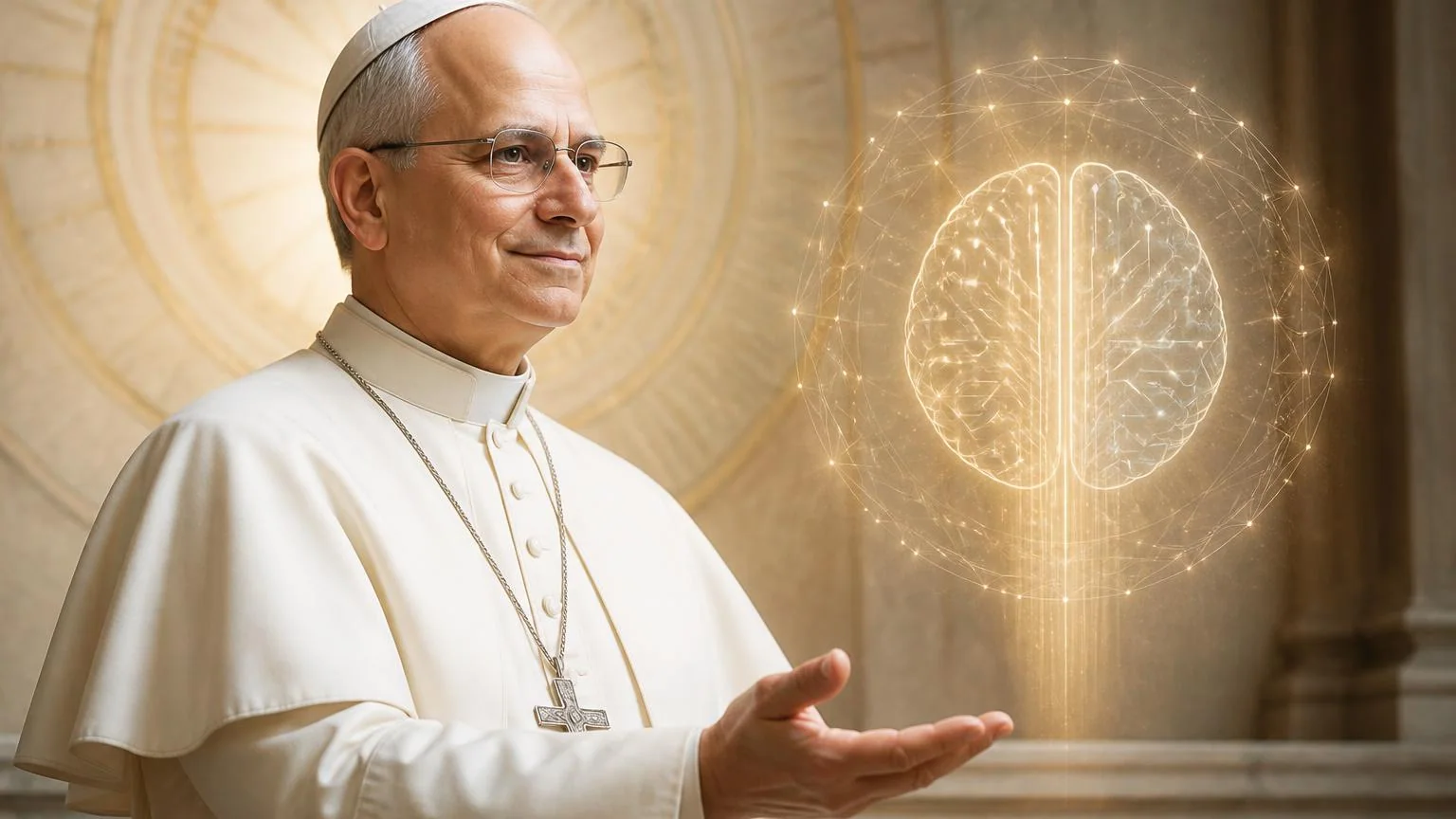
On May 25, 2026, Pope Leo XIV formally presented Magnifica Humanitas, his first encyclical, at the Vatican and used it to push artificial intelligence into a harder public debate about regulation, war, platform power, and human dignity. The document was signed on May 15, presented in the Synod Hall on May 25, and launched with Anthropic co-founder Christopher Olah among the speakers, making the event feel unusually close to the current AI industry rather than like a distant philosophical statement.
The immediate headline is straightforward: Leo XIV is calling for stronger oversight of AI and rejecting the idea that technical progress alone should determine how the technology is used. But the bigger story for businesses is that one of the world’s largest moral institutions has now packaged AI governance, concentration of digital power, and autonomy in war into one coherent public argument. That gives the AI policy debate a broader audience and a more durable frame than another company safety post or conference keynote.
What happened at the Vatican today
The Vatican released Magnifica Humanitas as Leo XIV’s first encyclical, a high-authority papal teaching document, and centered it entirely on “Safeguarding the Human Person in the time of Artificial Intelligence.” The official presentation had been scheduled in advance for May 25, 2026, and Leo used the event to frame AI as a transformation comparable in scale to the industrial upheaval addressed by Leo XIII’s Rerum Novarum.
In both the presentation and the encyclical itself, the pope argued that AI is already reshaping everyday life, political power, and warfare. He warned against allowing efficiency, control, and profit to become the default logic that governs human decisions, and he treated that risk as a social and political problem, not just a technical one.
“It is not permissible to entrust lethal or otherwise irreversible decisions to artificial systems.”
That line is one of the clearest parts of the document because it moves beyond vague AI ethics language. It directly challenges any normalization of autonomous systems making final decisions in warfare or other irreversible contexts.
Why this matters beyond a church document
It would be easy to file this away as a religious response to technology. That would miss what makes the news relevant. Magnifica Humanitas does not only talk about abstract dignity or spiritual caution. It speaks in concrete terms about patents, algorithms, digital platforms, technological infrastructure, and data as forms of power that can become too concentrated if left without adequate sharing, accountability, or oversight.
The document also pushes against the idea that AI governance can be left entirely to labs, vendors, or market incentives. Leo XIV argues that digital systems should be opened to discussion, debate, transparency, and meaningful participation rather than being shaped unilaterally by a small number of powerful actors. That puts the Vatican’s weight behind a broader international view that AI is not just a product category but part of social infrastructure.
For search readers looking for what changed today, the answer is that the AI debate just gained a new kind of authority. This is not a regulator writing a draft rule, and it is not a frontier lab publishing a system card. It is a major global institution saying that AI deployment now belongs inside debates about public legitimacy, human dignity, and who gets to govern technological systems.
Business impact for AI companies and enterprise buyers
For companies building or buying AI, the practical impact is less about immediate legal change and more about the direction of pressure. The document raises the cost of treating governance as a sidecar issue.
- Autonomy limits will get harder to ignore. If your product roadmap depends on AI taking action in high-risk settings, especially where decisions are irreversible, you should expect more scrutiny from customers, policymakers, and the public.
- Platform concentration is becoming a buying issue. The encyclical treats data, algorithms, and digital infrastructure as assets whose concentration can distort the common good. That lines up with enterprise concerns about lock-in, opaque model behavior, and dependency on a small number of vendors.
- Governance is moving beyond compliance teams. This is the kind of document boards, public-sector buyers, universities, healthcare systems, and multinational enterprises can cite when asking tougher questions about control, auditability, and human override.
- AI legitimacy now affects deployment speed. Even where no new law follows immediately, organizations that cannot explain why a system is safe, accountable, and human-supervised will face slower approvals and more internal resistance.
There is also a subtler signal here for AI labs. Christopher Olah’s presence at the Vatican presentation underlined that the frontier AI industry is now being pulled into debates far outside benchmark performance and product velocity. Labs increasingly have to answer not only whether a model can do more, but whether the governance around it is socially defensible.
What to watch next
The Vatican document does not create binding regulation on its own. But it can still matter because it adds moral and political weight to ongoing disputes over AI oversight, autonomous weapons, public accountability, and market concentration. In practice, that may show up in procurement language, public-sector guidance, board-level governance conversations, and how enterprise buyers justify where they do or do not let agents act independently.
For Nerova readers, the bottom line is simple: AI adoption is no longer only a capability race. It is also a control and legitimacy race. The companies that move fastest over the next year are likely to be the ones that can show where humans stay in charge, how agent decisions are constrained, and why their deployment model deserves trust before the next wave of regulation arrives.