
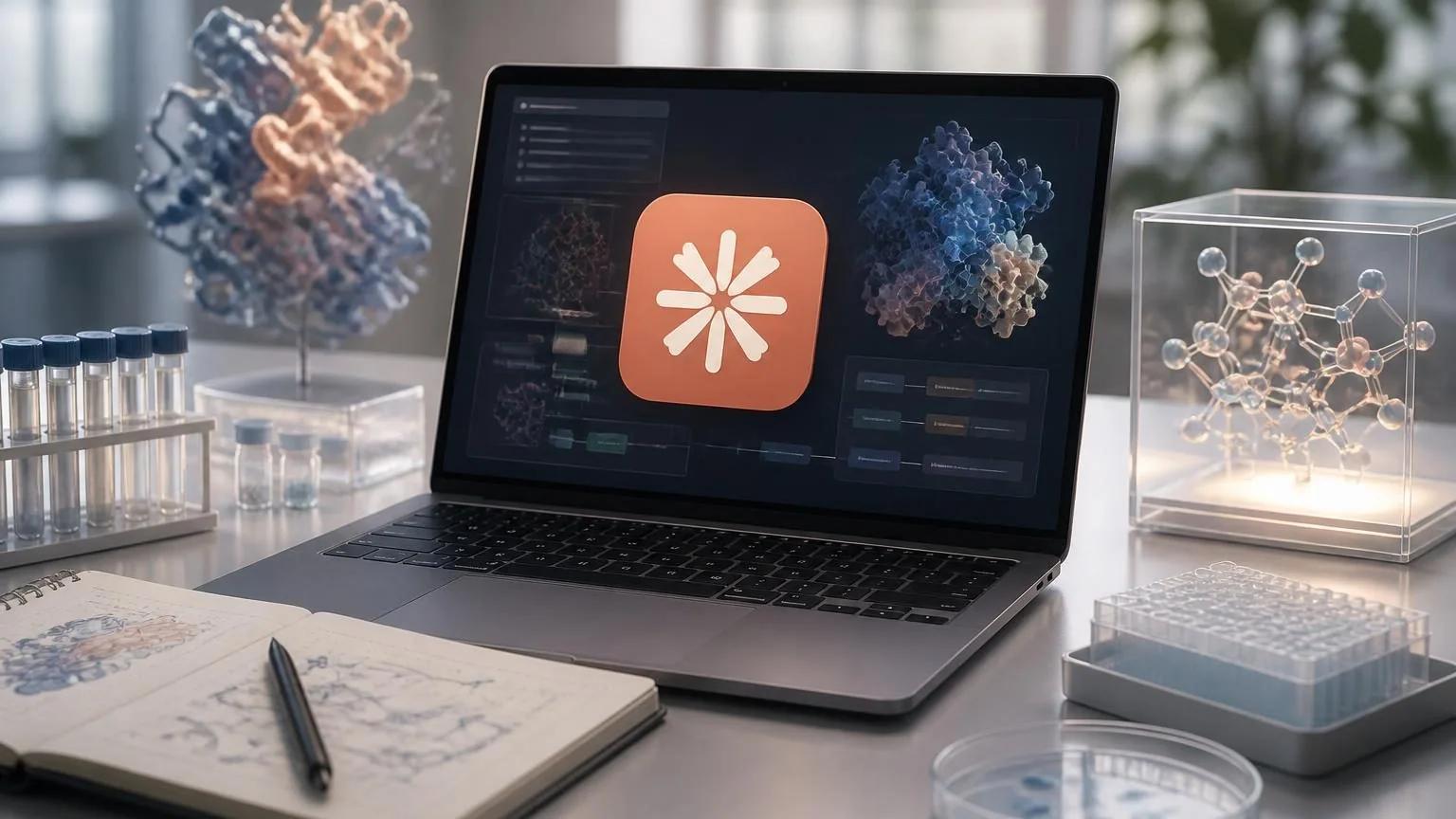
Anthropic used June 30, 2026 to make a very specific point: the next phase of AI is not just bigger models, but better workbenches for real work. Claude Science is now in beta as an AI workbench for scientists, and it moves Claude closer to a domain product than a generic assistant.
That matters well beyond life sciences. The launch shows how AI products are starting to win on connectors, reproducibility, and workflow control—the things that turn a promising model into something a team can actually trust.
What Anthropic launched
Claude Science is designed to bring literature review, data analysis, coding, compute, and manuscript creation into one environment. Anthropic says the app produces auditable artifacts, keeps track of how outputs were created, and lets users work across local machines and remote compute.
The company says the beta is available to Claude Pro, Max, Team, and Enterprise users on macOS and Linux. Anthropic also says Claude Science comes pre-configured with more than 60 scientific databases and can render scientific artifacts like protein structures, genome browser tracks, and chemistry drawings.
Why this launch matters for AI buyers
Claude Science is not just a science vertical. It is a proof point for a broader trend: buyers want AI that fits into an existing workflow instead of making them rebuild the workflow around the AI.
For business teams, three details stand out:
- Traceability: Anthropic is emphasizing auditable outputs and source code provenance, which is exactly what regulated and research-heavy teams care about.
- Connectors: The product works because it reaches the databases, tools, and environments scientists already use.
- Orchestration: The system can coordinate tasks and even use reviewer-style checks, which looks more like a workflow engine than a chatbot.
The bigger signal: vertical AI is getting sharper
This launch also fits Anthropic’s wider life-sciences push. The company says it is backing the rollout with an AI for Science program for up to 50 projects, offering up to $30,000 in credits and additional compute support from Modal. That tells you Anthropic sees science not as a demo, but as a real product line with a funnel around it.
For other industries, the lesson is simple: the winning AI product may not be the one with the flashiest model. It may be the one that makes a specific job easier, safer, and more reproducible.
What business teams should do next
If you are evaluating AI for research, compliance, operations, or knowledge work, Claude Science is a good benchmark for how mature a workflow product should feel. Ask whether your own AI plan includes connectors, audit trails, human review points, and clear boundaries around compute and data.
If it does not, you probably do not have an implementation plan yet—you have an aspiration. That is the gap worth closing first.
Bottom line: Claude Science is a product launch, but it is also a market signal. Vertical AI is moving toward specialized environments where trust, traceability, and workflow depth matter as much as raw model capability.