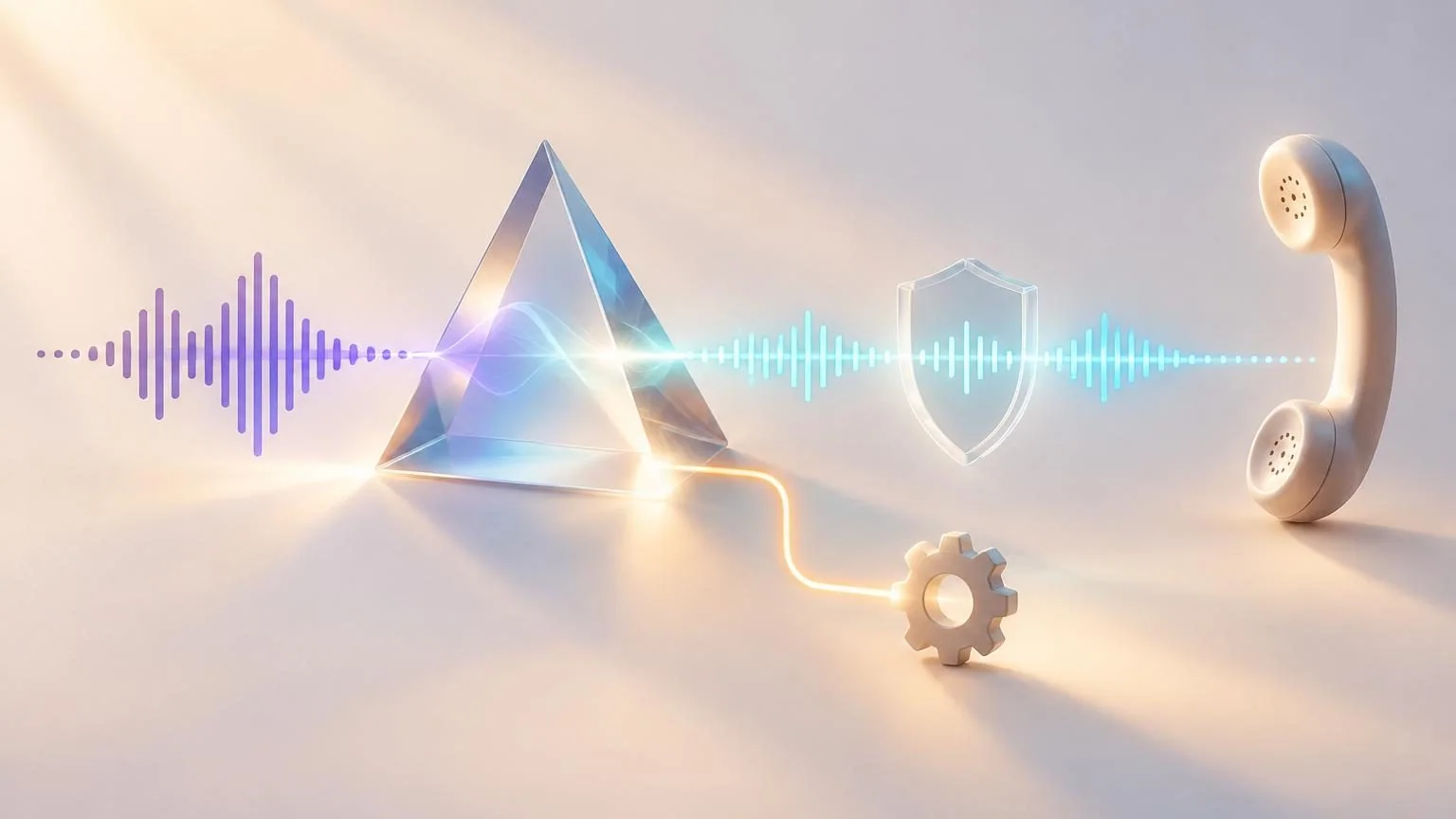
Rime launched Prism on October 28, 2026, as a speech-to-speech model for enterprise voice agents. A central feature is a text checkpoint that allows an application to inspect a reply before speech is generated. That design makes the boundary between fast conversation and application-controlled actions especially important.
What launched—and what remains a beta promise
Announcement: October 28 was the public Prism launch, not an open-weight release. Rime's press release also identifies Dialpad as a design partner looking forward to rolling Prism into its agentic products; that wording describes a planned rollout, not proof of deployment across those products.
API availability: As checked on November 1, Rime publishes a Prism WebSocket endpoint and SDK connection instructions. This is more than an announcement-only preview. However, those instructions alone do not establish a universal general-availability commitment or production service guarantees. The product page still says documentation is coming soon, despite live technical docs—a reason to consult the implementation documentation rather than infer availability from marketing copy.
Customization and weights: The launch post says self-serve reinforcement-learning and supervised fine-tuning APIs are being built with beta customers. Do not confuse that development program with a generally released training API. Rime advertises cloud, VPC and on-premises deployment, but the reviewed materials supply no public downloadable checkpoint or open-weight license. Private deployment is a commercial offering to verify, not permission to download and self-host.
The checkpoint changes the control point, not accountability
Rime describes Prism as processing caller audio directly, generating inspectable text before speech and running tool calls alongside speech. Unlike a transcript-only input pipeline, this design aims to preserve vocal context while exposing the proposed reply to application rules. These are Rime's architectural claims, not findings from a Nerova hands-on test.
Our operational reading: separate permission to speak from permission to act. In a hypothetical restaurant-ordering pilot, a rule could require the agent to read back the order before speaking its confirmation. A separate backend check should still prevent submitting that order until the caller has approved it. A safe sentence does not make a simultaneous tool request authorized.
That distinction matters when evaluating Rime's Revmo trial. The company reports order and pickup-method confirmations improving from 68% to 100%, and calls without dead air from 66% to 88%. These are vendor-reported results from a particular fine-tuned deployment, not guaranteed outcomes for a new customer's base-model integration.
Latency headlines need a narrower reading
The live announcement leads with about 300 milliseconds, but separately reports 0.57 seconds to first audio in its benchmark discussion. Rime says it ran Prism on Artificial Analysis's harness without a reasoning step before speech. Those figures should not be treated as interchangeable measurements or an independently verified speed guarantee; ask which timing boundary applies to your call path.
For a pilot, measure the interval from the caller's final audible word to the first useful response after your own policy checks. Record backend action completion separately. A quick acknowledgment can mask a slow lookup; neither metric alone proves the caller's task succeeded.
The launch limits that should shape a pilot
Rime's documentation lists English only and four Prism-specific voices: aurora, wawona, brando and astra. The hosted endpoint is in US East. Native audio is PCM16 at 16 kHz input and 24 kHz output, so telephone integrations need a bridge rather than assuming direct mu-law or G.711 compatibility. Prism also does not expose a choice of underlying language model or text-only replies.
The errors documentation specifies a 55-second continuous caller-turn limit and a five-minute idle timeout. A dropped session requires a new connection and restored conversation context rather than automatic resumption. Those constraints deserve deliberate long-answer, silence and disconnect tests before routing customer traffic.
For enterprise buyers revisiting this October 28 launch, the next milestone is evidence: demonstrate that the checkpoint can actually block an unsafe utterance, that tools enforce caller approval, and that interrupted calls recover correctly. Prism offers an interesting place to insert control; the business still has to prove the control works.