
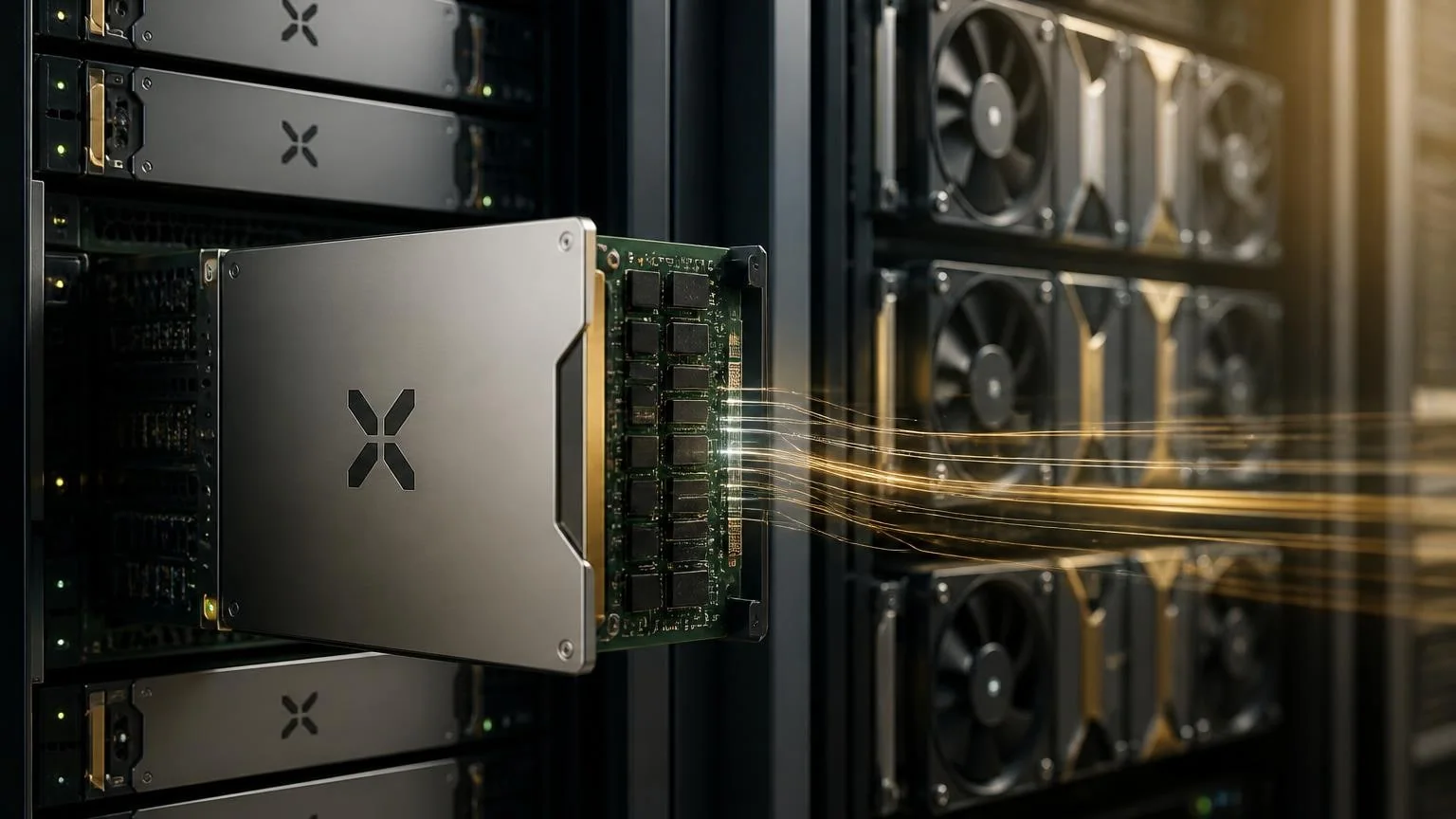
On May 29, 2026, TechCrunch reported that South Korea and U.S.-based startup XCENA had raised $135 million in a Series B round at a $570 million valuation, putting fresh attention on a different AI infrastructure thesis: the next bottleneck may sit in memory movement, not only in GPU supply. Earlier April deal records tied the round to KRW 150 billion in funding, and XCENA has been positioning its MX1 computational memory architecture as a way to handle more inference-side work closer to DRAM instead of forcing every step through the usual CPU-to-GPU path.
That makes this more than a startup funding update. XCENA is arguing that the real cost problem in AI inference comes from how often data has to move across the stack for preprocessing, KV-cache management, caching, and other supporting tasks that surround model execution. If that argument proves right, the competitive fight in AI infrastructure expands beyond bigger accelerators and into memory-centric system design.
What happened
According to TechCrunch’s May 29 report, XCENA’s Series B brings its total funding to $185 million and values the company at $570 million. MarketScreener records show an April 14 financing of KRW 150 billion, which lines up with the round later detailed in dollar terms. The company’s backers include Atinum, IMM Investment, Corstone Asia, SBI Investment, Mirae Asset Capital, and LB Investment, depending on the deal record cited.
XCENA was founded in 2022 by executives with Samsung and SK Hynix backgrounds, which matters because its pitch sits directly inside the memory layer that feeds modern AI systems. Rather than trying to out-Nvidia Nvidia on training chips, XCENA is building around CXL-connected computational memory, aiming to process more data operations near the memory module itself.
Why the memory angle matters now
Most AI infrastructure coverage still centers on training clusters, accelerator counts, and hyperscaler capex. XCENA’s bet is that inference economics are now exposing a different constraint. As agentic systems run longer tasks, manage more context, and keep larger working states alive across sessions, more value gets tied up in memory bandwidth, cache handling, and data shuffling before and after the actual model pass.
That is especially relevant for enterprise AI and AI agents. A production agent stack rarely performs one neat prompt-response cycle. It retrieves context, manages conversation state, calls tools, updates memory, handles structured and unstructured data, and often loops through multiple steps. Those workflows can become expensive not just because the model is powerful, but because the surrounding system has to keep moving data between components that were not designed for this style of work.
XCENA is trying to reduce that friction by moving more of those data-heavy jobs closer to DRAM. In practical terms, that means treating memory as a more active part of the inference path instead of leaving it as passive storage between CPU and accelerator activity.
What XCENA says it is building
XCENA’s MX1 connects through CXL and is designed to handle preprocessing, caching, KV-cache management, and related data tasks nearer to memory. The company has also said that the product combines custom processing cores, its own memory hierarchy, interconnect bus, and DRAM controller, which is part of its claim that it is more vertically integrated than some larger competitors.
The company’s earlier newsroom updates said it planned MX1 availability milestones and OCP demonstrations while preparing for Series B funding. In the May 29 TechCrunch report, XCENA said the current MX1 remains at the prototype stage, with mass-production chips expected from Samsung foundry lines by the end of 2026 and revenue targeted for 2027.
That timeline matters. The news does not mean memory-centric AI infrastructure has already won the market. It means investors are now willing to fund a more specific view of where inference bottlenecks are heading.
Business impact for AI infrastructure buyers
The biggest implication is strategic, not immediate procurement. Enterprise buyers and platform teams should read this as another sign that AI infrastructure decisions are shifting from a single-model, single-chip conversation toward a full workflow-efficiency conversation.
For hyperscalers, the attraction is obvious: even modest improvements in memory efficiency can translate into large savings when infrastructure budgets already run into the tens of billions. For enterprise AI teams, the signal is slightly different. They may not buy computational memory directly any time soon, but they will increasingly feel the downstream effects in model serving costs, context-window economics, infrastructure pricing, and the design choices vendors make around long-running agents.
This is also one more reason not to evaluate agent platforms only by model quality. In production, the winning stack is often the one that can manage context, data movement, tool calls, and execution state efficiently enough to keep real workflows affordable.
What to watch next
Three questions now matter. First, can XCENA turn a memory-centric architecture into a commercially credible inference advantage rather than a promising lab argument? Second, will hyperscalers and major cloud vendors adopt more of this design logic into mainstream AI serving stacks even if XCENA itself stays a component player? Third, will agent-heavy workloads make the memory layer important enough that buyers start treating it as a first-class architectural decision?
For Nerova readers, the near-term lesson is straightforward: AI agent performance is increasingly shaped by infrastructure choices that sit below the model layer. As enterprises push toward longer-running, more stateful, more tool-using automation, the economics of memory, context handling, and orchestration may become just as decisive as the headline model benchmark.