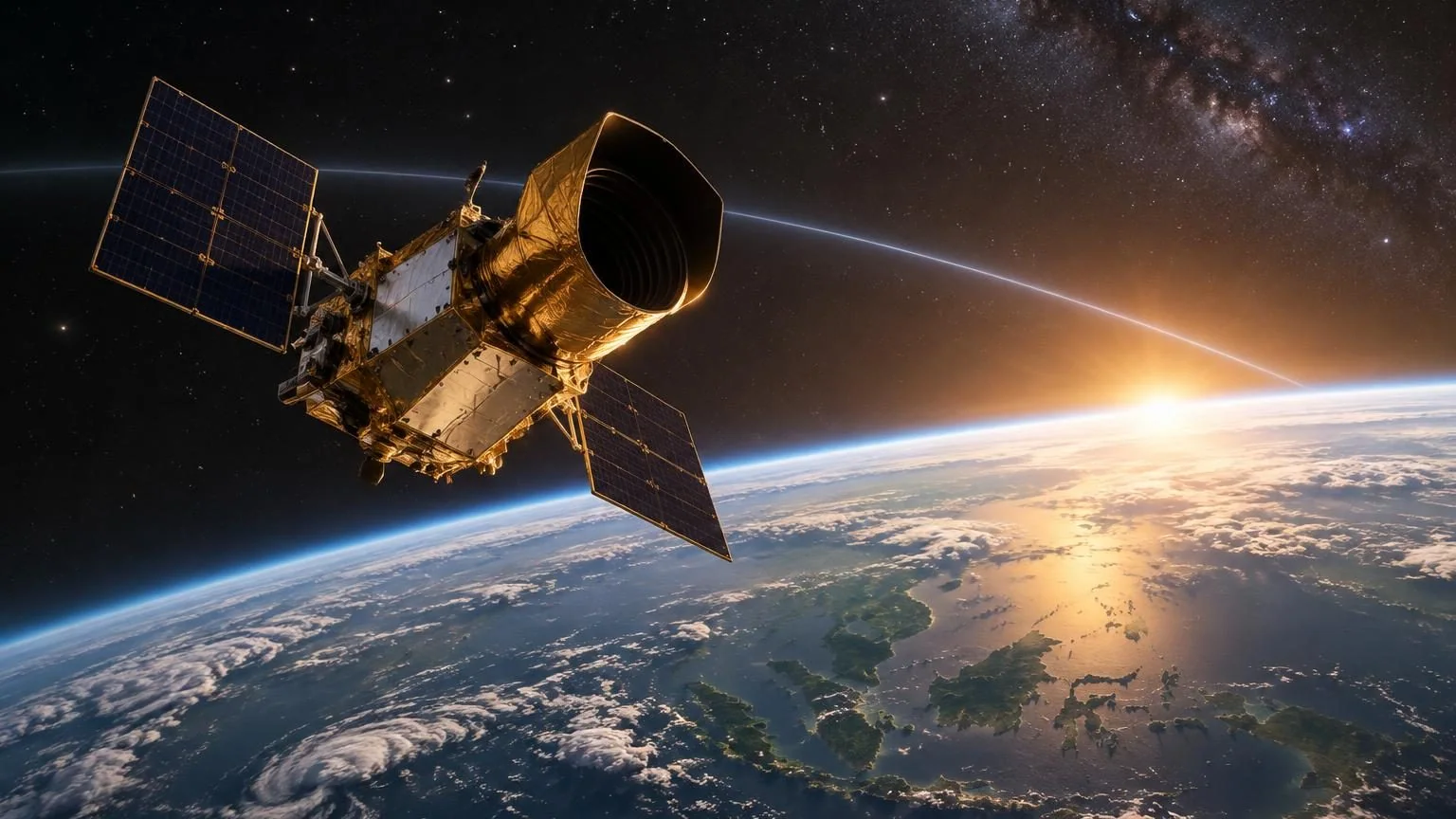
NASA confirmed that the Neil Gehrels Swift Observatory re-entered Earth’s atmosphere on November 4, 2026, almost 22 years after launch. The update closes the physical lifecycle of a spacecraft whose rapid observations helped astronomers respond to short-lived cosmic events.
The timing of the confirmation
NASA’s notice was originally published on November 2 and updated on November 4 with the confirmed outcome. According to the agency, the U.S. Space Force placed reentry at 7:39 a.m. EST over the North Sumatra region of Indonesia. NASA expected most of the spacecraft to burn up, while some components could have survived. The notice does not report recovered debris.
Swift launched in 2004 with a planned two-year prime mission. Its three telescopes observed across different wavelengths, and the spacecraft could quickly point toward transient events and alert other facilities. The mission’s official page documents that scientific role and directs readers to its wider research history.
A technology story about response time
Our interpretation is that Swift’s lasting engineering lesson concerns the relationship between detection and coordinated action. Some scientific opportunities are temporary. Recognizing an event is only the start; the system must also point instruments, collect useful measurements, and tell other observers soon enough for their contribution to matter.
That pattern extends beyond astronomy as an engineering idea. A monitoring system becomes more useful when its alerts carry enough context for the next participant to act. An alert without timing, location, or a clear handoff can leave a capable instrument waiting. Swift’s observing concept makes the entire response chain worth examining.
Separate the mission’s different endings
A science mission can have several closing milestones. The end of routine observations, final spacecraft operations, and atmospheric reentry describe different events. Keeping those dates distinct helps readers understand what a new announcement actually adds.
The November 4 confirmation concerns the spacecraft’s return through the atmosphere. It should not be read as a claim that the mission’s accumulated observations suddenly lose their scientific relevance. Researchers can continue to ask questions about historical measurements when the supporting data and documentation remain accessible.
What readers can explore now
NASA’s mission resources offer a starting point for understanding Swift’s instruments and scientific purpose. A useful retrospective follows the observations and the collaborations they enabled, rather than judging the spacecraft only by its final day. The November update establishes the reentry outcome; the broader story is a long-lived observatory designed to help a distributed research community react while an event was still unfolding.