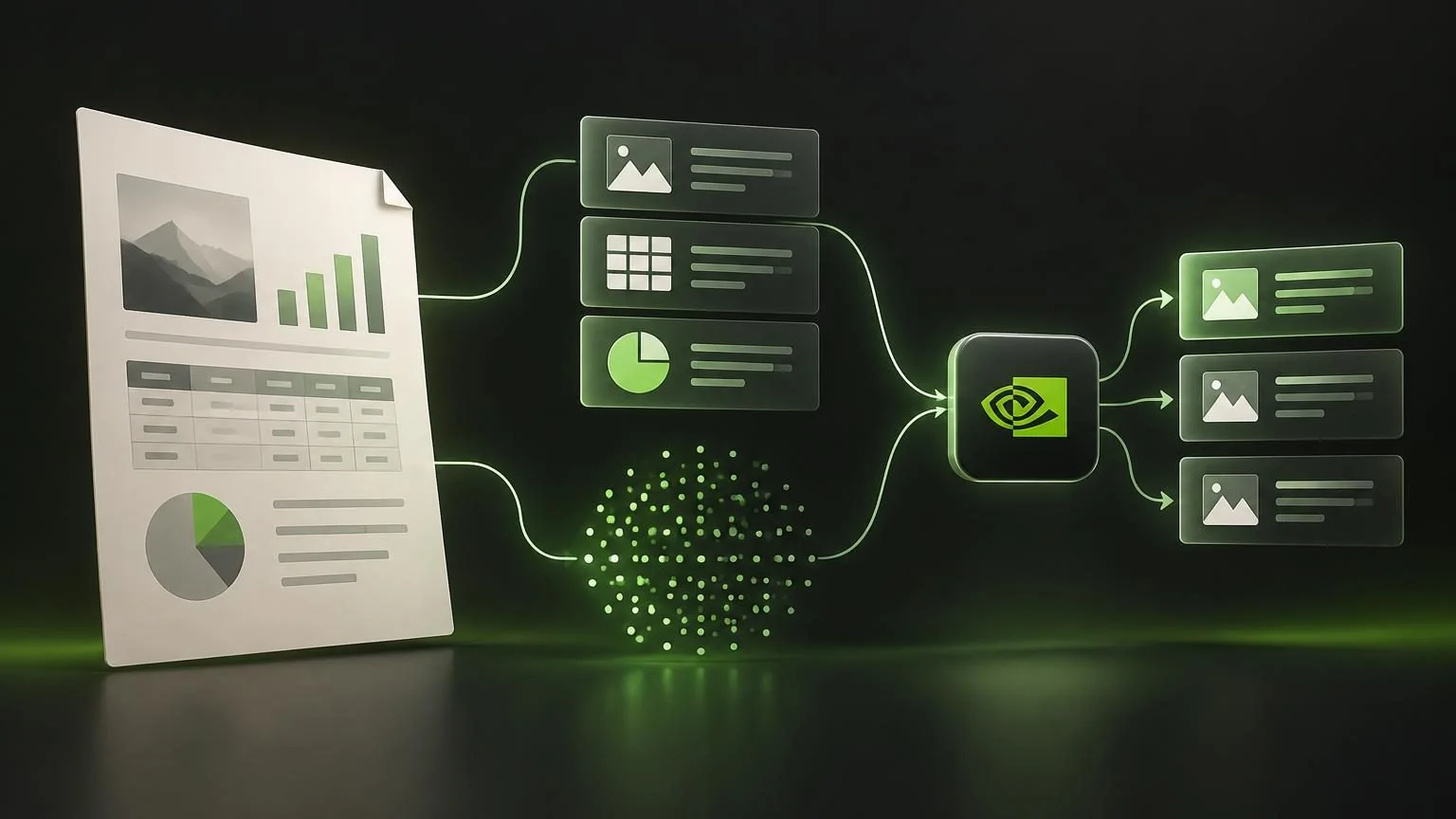
NVIDIA’s October 21, 2026 announcement expanded Nemotron Retriever with Nemotron 3.5 Embed 1B and 8B, Rerank 8B, and Parse. The models address different steps in retrieving evidence from visual documents: locating relevant pages, ordering candidates, and extracting usable structure from charts, tables, and text.
The release dates are not interchangeable
NVIDIA’s Hugging Face model cards date the Embed 1B BF16, Embed 8B BF16 and Rerank 8B BF16 releases to October 20, 2026. The family announcement followed on October 21, including an additional Embed 1B NVFP4 checkpoint.
Parse requires a correction to that chronology: its model card explicitly lists October 17, 2026 as its Hugging Face release. It was included in the October 21 retrieval announcement, but that was not its initial weight release. NVIDIA’s Parse NIM container catalog carries an October 20 update timestamp; an updated container listing is a separate milestone, not proof of a first model launch.
Accordingly, this is coverage of the October 20–21 retrieval expansion, not a claim that every component first appeared together.
Three components address different evidence failures
Embed finds candidate evidence. The embedding models accept document text, page images or both, while queries are text-only. NVIDIA’s 8B card specifies a 32,768-token context and 4,096-dimensional output vectors. The 1B BF16 model produces 2,048-dimensional vectors; its card lists 1.55 billion total parameters, so the product name should not be treated as an exact deployment-size specification.
Rerank orders the shortlist. Rerank 8B jointly evaluates a text query and each candidate document, including image-based candidates, and returns a relevance logit. That is a ranking signal, not a calibrated probability that an answer is correct. Operationally, teams should test candidate retrieval and final ordering separately: a reranker cannot rescue evidence excluded from its shortlist.
Parse extracts usable structure. The roughly 631-million-parameter parser produces text, semantic layout classes, bounding boxes and reading order. Its postprocessing tools can turn supported table and chart outputs into structured formats. For a procurement agent, our interpretation is that visual retrieval could locate the relevant supplier page, while parsing could expose the rows needed for a quantity check. Neither step alone establishes that the agent’s eventual calculation is correct.
Downloadable weights are not the same as a production API
The model cards provide downloadable checkpoints and local inference instructions. This is therefore more than a preview announcement without weights. NVIDIA Build also lists hosted endpoints, including Embed 1B, Rerank 8B and Parse. The Rerank page explicitly describes a development API subject to rate limiting and shared-traffic throttling.
Those pages establish access as checked on November 1; they do not establish an exact first hosted-API date or a production service commitment. Nor should an interface’s “Preview” output tab be mistaken for a formal model-preview designation.
For self-managed embedding inference, NVIDIA’s NIM 2.4 release notes list both embedding sizes and the 1B NVFP4 variant. Hardware support differs: the documented NVFP4 path runs on GB200, B300 and RTX PRO 6000 Blackwell Server Edition, whereas the 1B BF16 support list is broader. Procurement should distinguish checkpoint licensing, container terms and hosting arrangements rather than assuming one access route covers all three.
Promising results still leave a deployment decision
NVIDIA reports that adding Rerank reduced agent inference tokens per query by approximately 13% with Embed 1B and 14% with Embed 8B in its evaluation. These are vendor-reported results, not tests reproduced by Nerova. Fewer agent tokens do not automatically mean a lower total operating bill: reranking, document rendering, indexing and GPU serving still consume resources.
The parser’s limitations also matter. Its model card warns that strong OCR results on simply rendered synthetic text do not guarantee accuracy on handwriting, degraded scans or complex real-world pages.
Our recommendation for evaluating this release is a bounded document pilot: retain original pages, label the evidence needed for representative questions, and measure candidate recall, final ranking, extraction errors and complete task latency separately. Include scanned tables and visually encoded exceptions—not just clean prose. The October release makes those workflows worth testing; it does not remove the need to verify evidence before an agent acts.